The Thinking Machine Chronicles #0015: Can Machines Think?: Turing's Imitation Game and the Test That Changed Philosophy
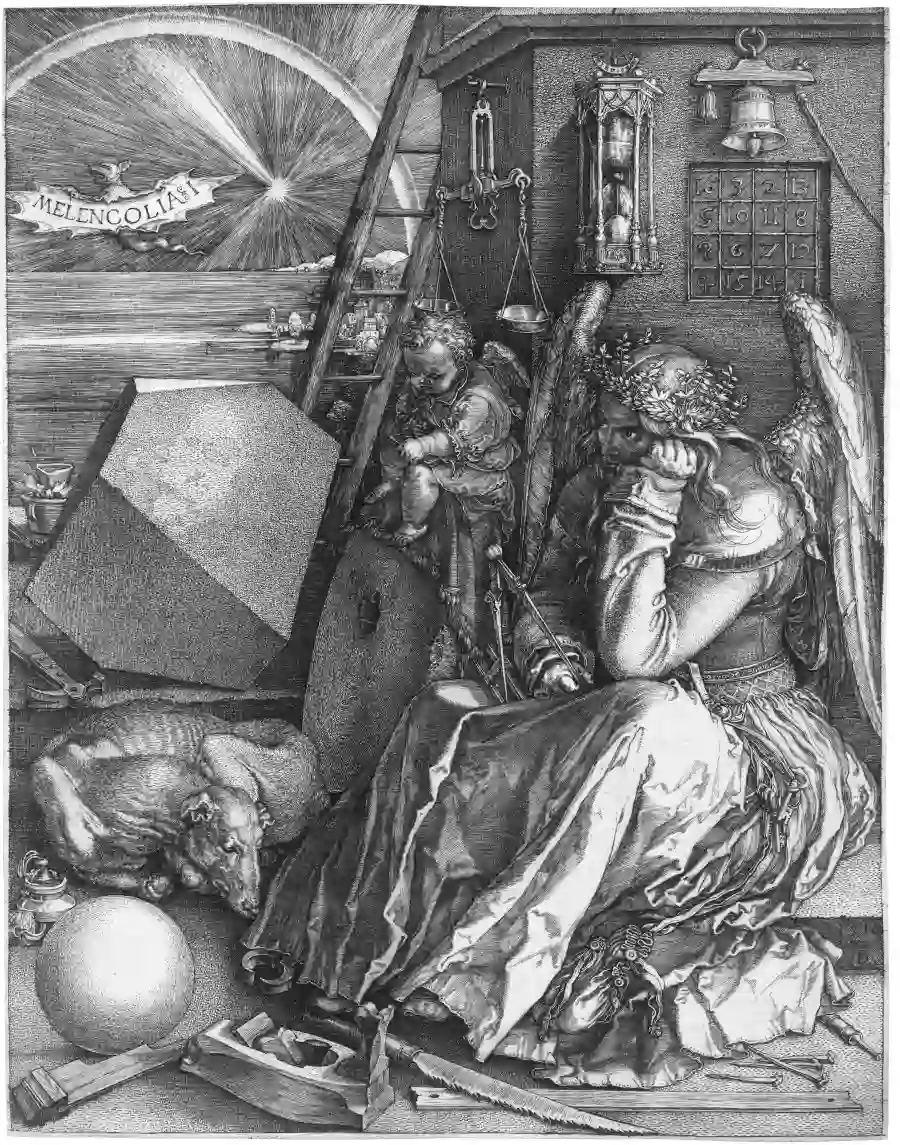
Albrecht Dürer, Melencolia I, 1514. Engraving, 23.9 × 18.8 cm. Städel Museum, Frankfurt. Public domain (artist died 1528). Dürer's brooding angel sits surrounded by tools of reason but cannot act, a meditation on the gap between the instruments of thought and thought itself that Turing would close, four centuries later, with a deceptively simple game.
Era 1 · The Foundations (1936–1955) A mathematician at Manchester poses a question so simple it seems naive: can machines think? Then immediately replaces it with a different question, one that can actually be answered. The substitution changes everything.
The World in 1950
The year 1950 opened with the Cold War no longer hypothetical. The Soviet Union had detonated its first atomic bomb in August 1949, and in January 1950 President Truman authorised the development of the hydrogen bomb, a weapon whose yield would dwarf the Hiroshima bomb by a factor of a thousand. Senator Joseph McCarthy gave his famous speech claiming 205 Communists had infiltrated the State Department, igniting four years of political paranoia that would consume careers and reputations across American public life. On 25 June, North Korean forces crossed the 38th parallel into South Korea; within days the United States and a United Nations coalition were at war, and the first major conflict of the nuclear age was under way on a peninsula that most Americans could not have located on a map three months earlier.
In January, India's new constitution came into force, making it the world's largest republic and the world's largest democracy in a single stroke. The People's Republic of China, proclaimed in October 1949, was consolidating its revolution across a country of 540 million people. In Britain, the National Health Service was completing its second year of operation, the welfare state was being assembled piece by piece, and rationing, still in effect five years after VE Day,was becoming a political flashpoint. The intellectual climate was shaped by Orwell's recent death, by the publication of Simone de Beauvoir's The Second Sex, and by the growing conviction that science, having produced the atomic bomb, owed humanity a reckoning about what it was for.
The Question That Couldn't Be Answered
Alan Turing had been thinking about machine intelligence for at least a decade. His 1936 paper on computable numbers had defined computation in terms of an abstract machine reading symbols on a tape, and from the beginning he had understood that the same model that defined the limits of mathematics also defined the theoretical capacity of any computing device. If computation was formal symbol manipulation, then a sufficiently powerful computer could, in principle, do anything that could be specified formally. The question was whether thought itself was formal symbol manipulation.
The problem with asking "can machines think?" is that the word think is irreducibly vague. Philosophers had spent centuries arguing about what it meant for a human to think, let alone a machine. Turing's masterstroke in his October 1950 paper "Computing Machinery and Intelligence," published in the philosophical journal Mind, was to notice that this question was unanswerable in its current form and to replace it with something concrete.
His substitution was the Imitation Game. In its original form, it involves three players: a human man (A), a human woman (B), and an interrogator (C) who cannot see A or B and communicates with both only by written messages. The interrogator's task is to determine which is which. A's task is to deceive the interrogator; B's task is to help the interrogator identify her correctly. Now replace A with a computer. The question "can machines think?" becomes: "Can a computer, playing A's role, fool the interrogator as often as the human man could?" If a machine can play the imitation game as well as a human, Turing argued, we have no principled grounds left for denying that it thinks.
The Mathematics of the Game
The Turing Test is not a mathematical result but a philosophical proposal. Its rigour comes from what it refuses to assume. Turing laid out nine Objections to the idea that machines could think and systematically demolished each one. The structure of his demolition is worth following:
The Theological Objection: Thinking requires a soul; machines have no souls; therefore machines cannot think. Turing replies: this argument also forbids God from bestowing souls on machines, which is theologically presumptuous.
The Mathematical Objection (the strongest one): Gödel's incompleteness theorems show that any sufficiently powerful formal system contains true statements that cannot be proved within the system. Machines are formal systems; therefore machines have inherent limitations that humans do not. Turing's reply is nuanced: yes, the Halting Problem shows that for any machine , there exists a statement that cannot correctly evaluate. But this only proves that specific machines have specific limitations, it does not prove that humans lack analogous limitations. We simply cannot interrogate our own incompleteness from inside our own cognitive system.
The mathematical structure Turing is implicitly using is the diagonal argument. For any machine from the enumerable sequence of Turing machines , Turing's undecidability result constructs a statement that cannot decide. An adversary could use this to stump in the imitation game. But:
This is a per-machine limitation, not a proof that humans in general can decide every . Human mathematicians also cannot solve the Halting Problem; they simply encounter the diagonal argument from a different angle.
The Consciousness Objection: Unless we believe a machine is experiencing something, fear, joy, grief,we have no grounds for calling what it produces "thinking." Turing invokes solipsism: the only mind we can be directly certain of is our own. We attribute consciousness to other humans by behavioural inference. If we require internal experience as a criterion, we should logically also deny that other humans think.
The Heads in the Sand Objection: We simply do not want machines to be intelligent, because it would be disturbing. Turing regards this as not worth dignifying with a logical reply.
The Imitation Game as Operational Definition: Turing's final position is that the question "can machines think?" is too poorly defined to have a meaningful answer and should be replaced by the operational question: does the machine pass the imitation game? This is a move from metaphysics to engineering, a move that defined the next fifty years of AI research.
"Computing Machinery and Intelligence" (1950)
Turing's paper appeared in Mind: A Quarterly Review of Psychology and Philosophy, Vol. 59, No. 236, October 1950, pp. 433–460. It is unusual for a technical result because it contains almost no mathematics, the argument is entirely philosophical and rhetorical. Turing reportedly wrote it quickly, almost impatiently, as a provocation rather than a formal treatise. It has since become the most-cited paper ever published in Mind, and one of the most cited in cognitive science. The word "Turing Test" does not appear in the paper; it was coined by others later.
Turing, A.M. (1950). Computing Machinery and Intelligence. Mind, 59(236), 433–460.
The Code: Imitation Game Simulator
The companion project implements the Turing Test as a scoring experiment: a rule-based chatbot plays against a human-scripted response set, and a simulated interrogator awards points based on plausibility. The core evaluation loop:
def interrogate(chatbot: Chatbot, human: Human, rounds: int = 10) -> TuringResult:
    """Run the imitation game and score both players."""
    scores = {"machine": 0, "human": 0}
    for question in INTERROGATOR_QUESTIONS[:rounds]:
        machine_reply = chatbot.respond(question)
        human_reply   = human.respond(question)
        winner = judge(question, machine_reply, human_reply)
        scores[winner] += 1
    return TuringResult(
        machine_score=scores["machine"],
        human_score=scores["human"],
        machine_pass=scores["machine"] >= rounds // 2,
    )
The full project includes the question bank, a keyword-matching chatbot, a scripted human baseline, a scoring rubric, and a statistical analysis of how often the chatbot's answers are ranked more plausible than the human's.
Why It Mattered
Turing's 1950 paper mattered for reasons that had nothing to do with whether the Imitation Game was the right definition of machine intelligence. It mattered because it shifted the question from metaphysics to engineering. Before 1950, asking whether a machine could think was asking a question about consciousness, souls, and the nature of mind, questions that had defeated philosophers for centuries. Turing replaced this with: build a machine that behaves indistinguishably from a thinking human in a specified task. This is a programme of work, not a philosophical debate.
The paper also legitimised AI as a serious research programme. In 1950, "artificial intelligence" was not yet a term, that would come from Dartmouth in 1956. But Turing's paper provided the conceptual licence to ask, without embarrassment, whether machines could have human-level capacities. It established that the question was not obviously absurd. This was not a trivial contribution in an intellectual climate where the dominant view was that machines were mere calculators, categorically incapable of anything resembling cognition.
The Turing Test also, somewhat paradoxically, generated the most productive series of objections in cognitive science. John Searle's Chinese Room argument (1980), a man in a room uses symbol manipulation rules to produce correct Chinese outputs without understanding Chinese,was a direct attack on Turing's behaviourist criterion. The debate between Turing's behaviourism and Searle's intentionalism shaped the philosophy of mind for decades and forced cognitive scientists to be more precise about what they meant by understanding, meaning, and intentionality.
What Came Next
The Turing Test established a behavioural standard for machine intelligence; the next question was how to build a machine that could meet any part of that standard. In the same year, Claude Shannon, who had given information theory its mathematical foundation two years earlier,published a paper that was more constrained but more immediately useful: a blueprint for programming a computer to play chess. Shannon's paper was not about the philosophical question of whether a chess-playing computer "understood" chess; it was about the algorithms and heuristics needed to make a machine play it well. That is the next story: .
References
- Turing, A.M. (1950). Computing Machinery and Intelligence. Mind, 59(236), 433–460. The source text; every subsequent debate in the philosophy of AI traces back here.
- Searle, J.R. (1980). Minds, Brains, and Programs. Behavioral and Brain Sciences, 3(3), 417–424. The Chinese Room argument, the most influential objection to Turing's behaviourist criterion.
- Harnad, S. (1991). Other Bodies, Other Minds. Minds and Machines, 1(1), 43–54. The "symbol grounding problem" as a reformulation of what the Turing Test actually tests.
- French, R.M. (2000). The Turing Test: The First Fifty Years. Trends in Cognitive Sciences, 4(3), 115–122. A retrospective on what the test did and did not achieve in half a century of AI research.
- Copeland, B.J. (2004). The Essential Turing. Oxford University Press. The authoritative collection of Turing's papers with editorial commentary; Chapter 5 reprints the 1950 paper in full.
- Hofstadter, D.R. (1979). Gödel, Escher, Bach: An Eternal Golden Braid. Basic Books. The most thorough exploration of the connection between Gödel's theorems and machine intelligence.