CREDENTIALS
25 years of learning on the job — and the formal evidence that the deliberate kind matters too. Every certificate here represents a decision to slow down, go deep, and come back sharper.
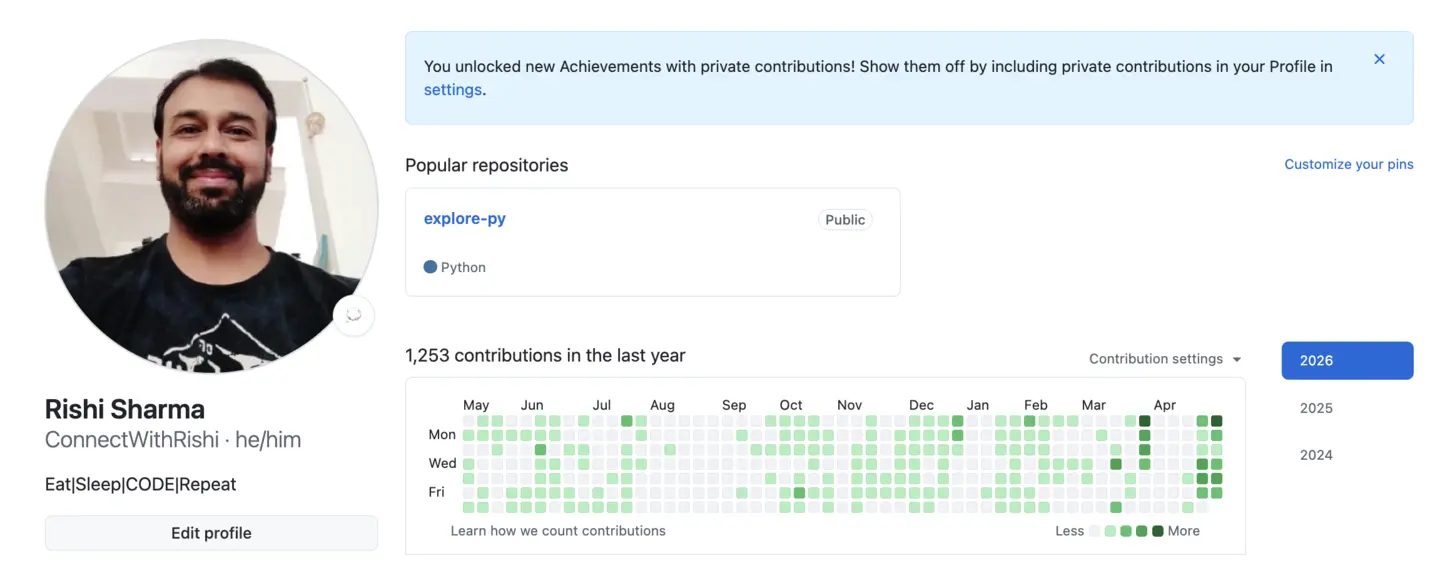
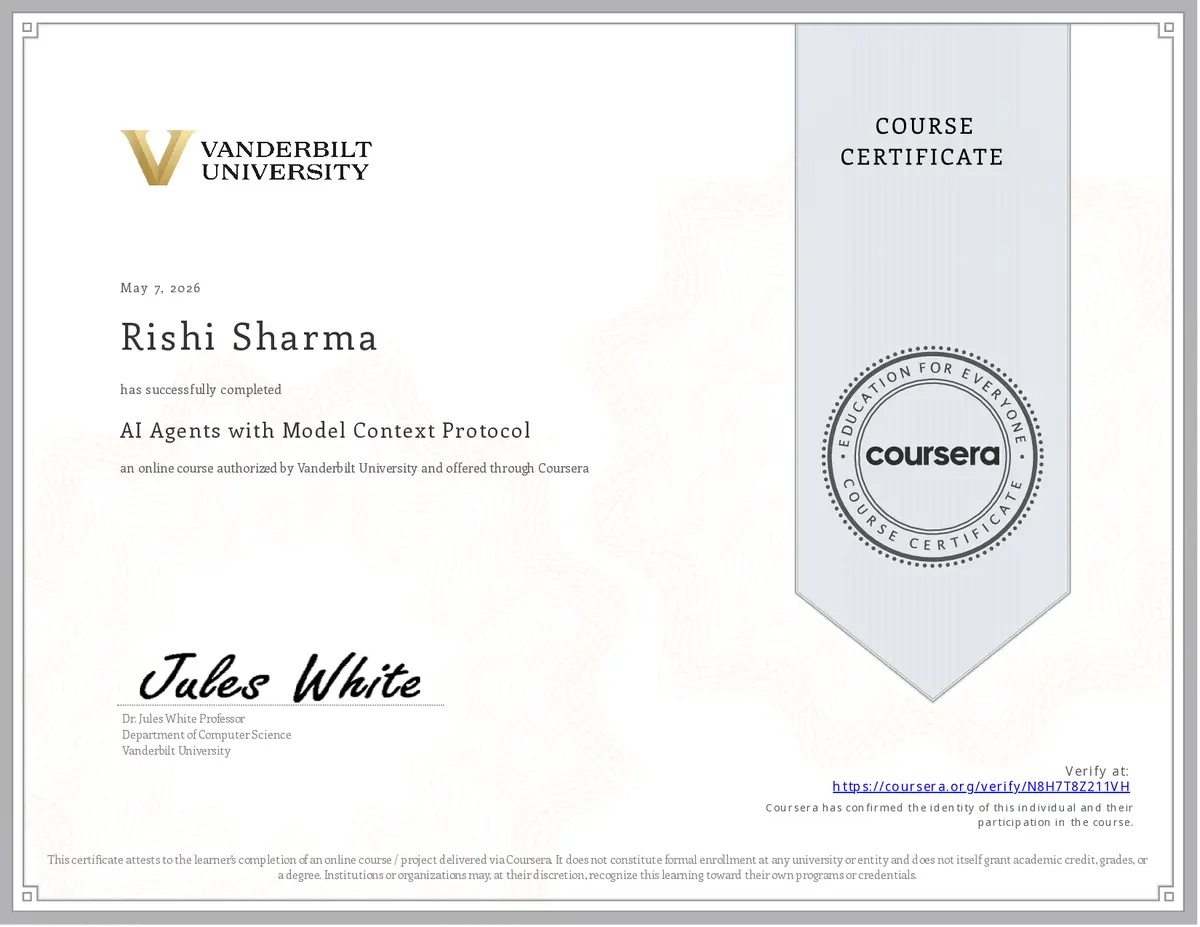
AI Agents with Model Context Protocol
Model Context Protocol is the emerging standard for connecting AI agents to external tools and data sources — and Vanderbilt's course, taught by Professor Jules White, is the definitive technical treatment of it. I completed this in May 2026 as direct preparation for building MCP-native systems into our AI infrastructure at Nutcake.ai.
The course covers the full protocol: how MCP servers expose tools, how agents negotiate capabilities, and how to build reliable multi-agent pipelines that compose cleanly. When you are designing AI architecture, understanding the protocol at this level means you are making decisions based on reality, not marketing claims.
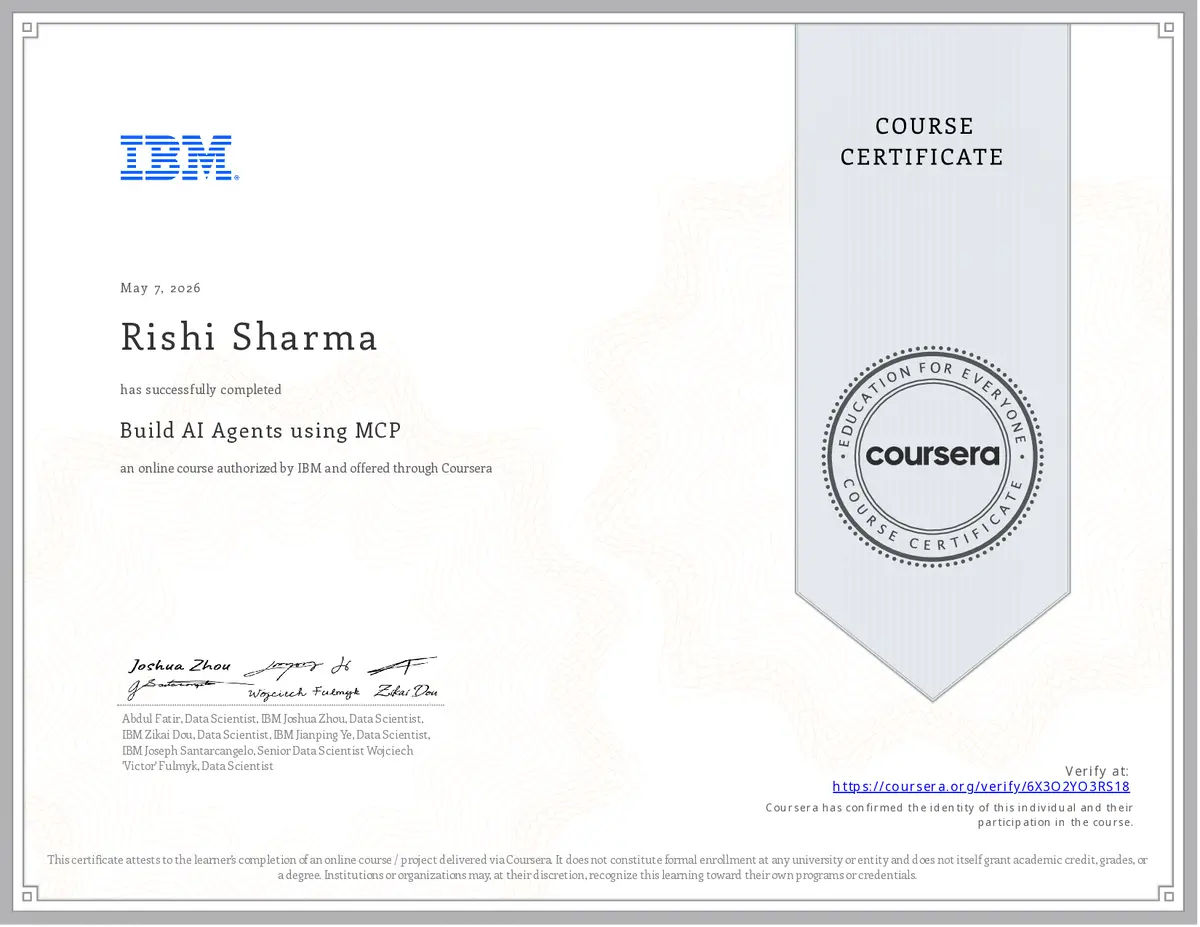
Build AI Agents using MCP
IBM's MCP course approaches agent construction from a production engineering perspective — not just the theory of how agents communicate, but how you build, test, and deploy them at scale. Completed alongside the Vanderbilt MCP course in May 2026, this gave me a second lens on the same protocol: where Vanderbilt focused on the architecture, IBM focused on the implementation.
The instructors — Abdul Fatir, Joshua Zhou, Zikai Dou, Jianping Ye, Joseph Santarcangelo, and Wojciech Fulmyk — bring genuine research depth. When I make architectural decisions about our AI agent stack, I want them grounded in what the people building these systems at IBM and Vanderbilt actually know. This is how I stay current without losing the engineering rigour.
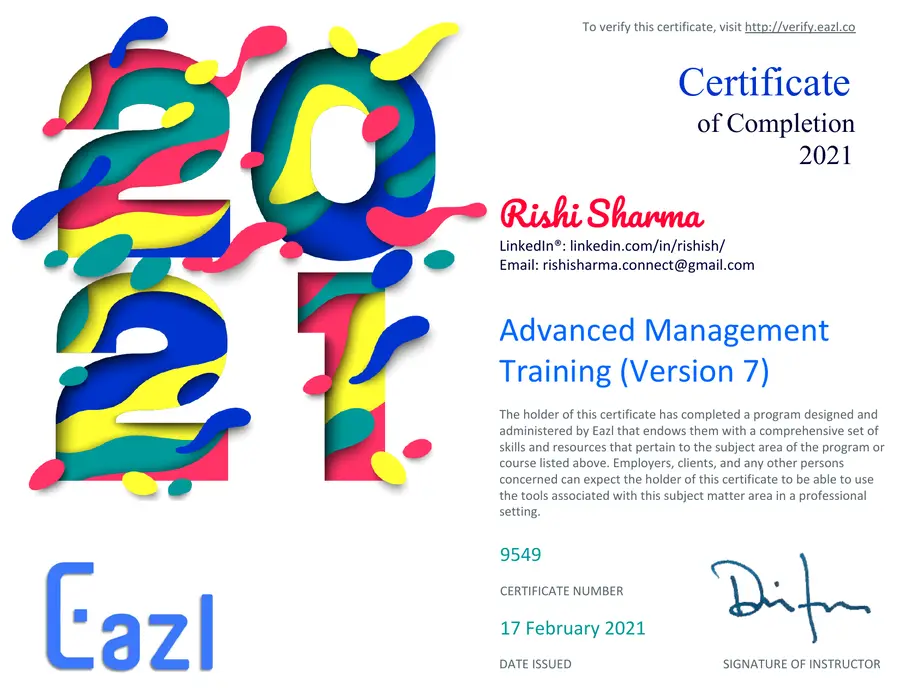
Advanced Management Training
Twenty years of leading engineering teams teaches you a lot. This formalised it. The Eazl Advanced Management Training isn't something you take to learn theory — it's something you take to pressure-test what you already believe about managing people, priorities, and performance under real conditions.
What I took away was sharper vocabulary for conversations I'd been having for years, and a framework that validated what I had learned the hard way across Motorola, Microsoft, Tesco and beyond. Sometimes the most valuable thing a senior leader can do is stop and verify their instincts against proven models. This was that moment.
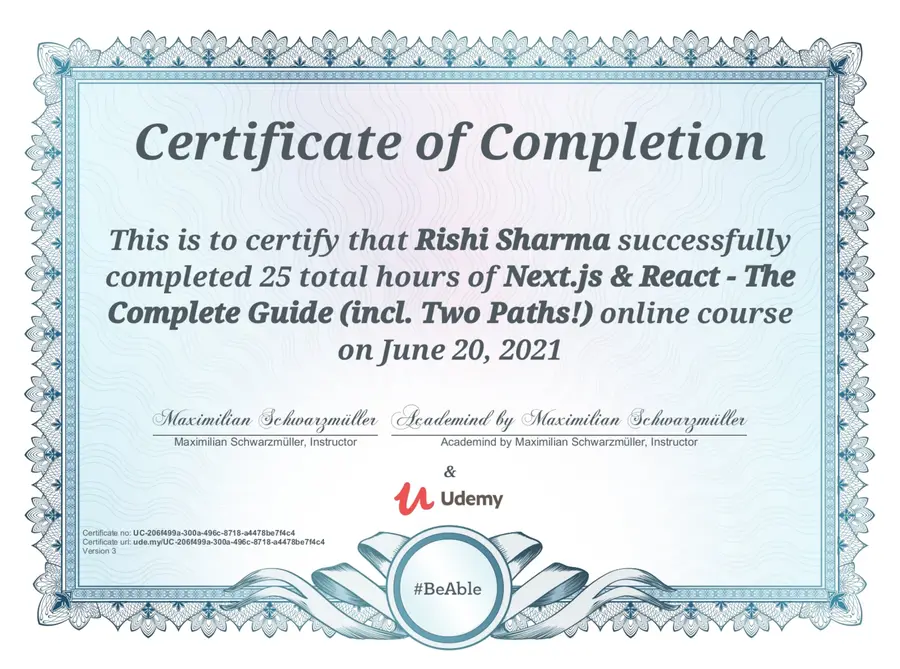
Next.js & React — The Complete Guide
25 hours. That is what it takes to go from framework-curious to framework-competent in Next.js. I completed Maximilian Schwarzmüller's flagship course — widely regarded as the gold standard for modern React development — as direct preparation for building Nutcake.ai.
Understanding how Next.js handles routing, server-side rendering, API routes, and deployment at a deep level means I can make architectural decisions on the stack we are betting the company on, not delegate them. After 25 years in engineering, I still believe the leaders who understand the tools make better decisions than the ones who don't. This site itself runs on Next.js.
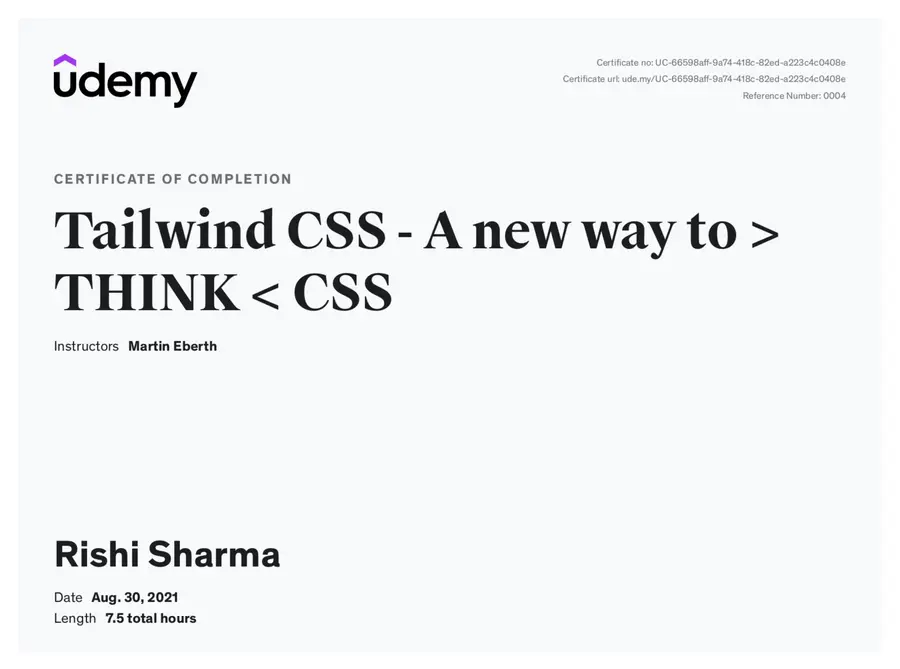
Tailwind CSS — A New Way to Think CSS
Tailwind was polarising when it emerged. Utility-first CSS felt wrong to a generation raised on semantic class names and BEM methodology. 7.5 hours with Martin Eberth changed my view completely.
Understanding why Tailwind works — not just how to use it — made me a sharper reviewer of frontend work and a better architect of the design system we built for Nutcake.ai. When you lead frontend teams, knowing the tool deeply enough to challenge decisions is the difference between good leadership and abdication. For the record: this site is built on Tailwind.
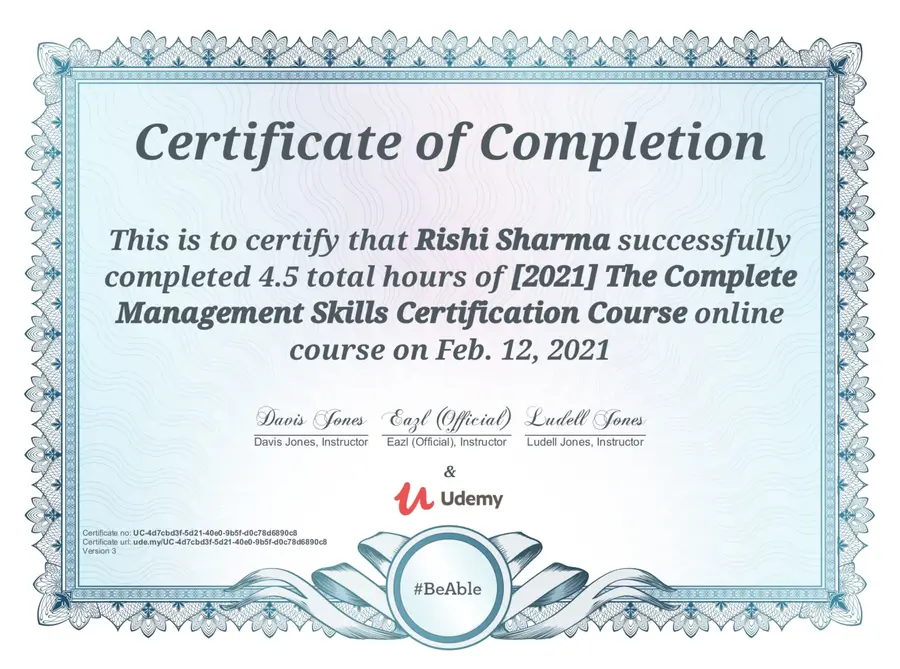
Complete Management Skills Certification
Four and a half hours covering the full arc of management — from hiring to letting go, from motivating to holding accountable. What makes this course different is its practical grit. No platitudes. Real frameworks for real situations.
I completed it to stress-test my instincts against proven models, and to equip myself to coach the next generation of engineering managers at Nutcake.ai. The best leaders are the ones willing to remain students. This was deliberate professional investment, not box-ticking.
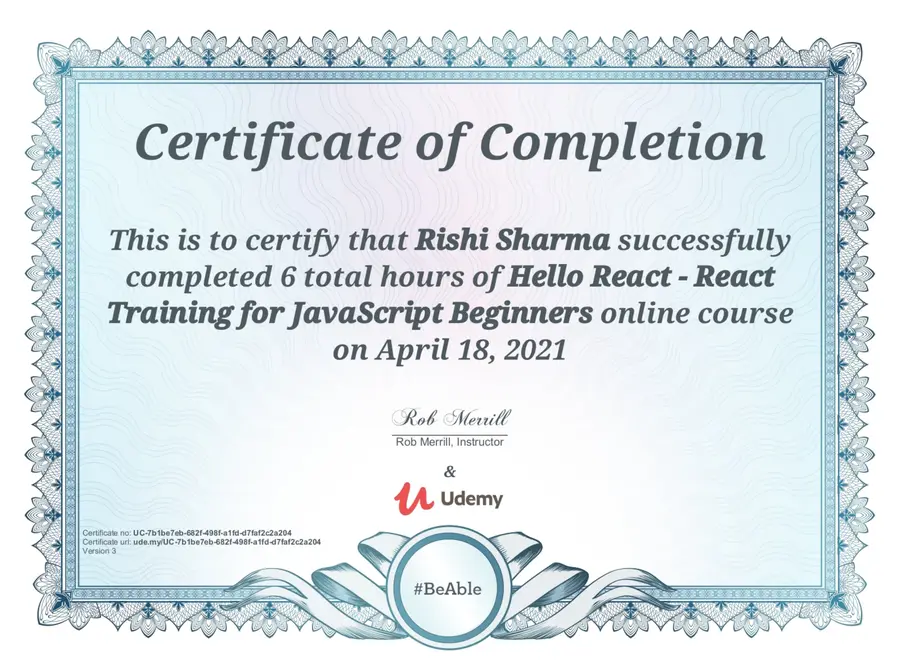
Hello React — React Training for JS Developers
25 years in engineering taught me one thing above all else: the moment you stop understanding the tools your teams use, you lose the ability to make good architectural decisions. React was everywhere in 2021 and I wanted to understand it from the ground up — not from a CTO's 30,000-foot view, but with my hands in the code.
Six hours later I had the foundation needed to evaluate React-based architecture choices with genuine confidence rather than deference to whoever was in the room. That shift matters more than most leaders admit.
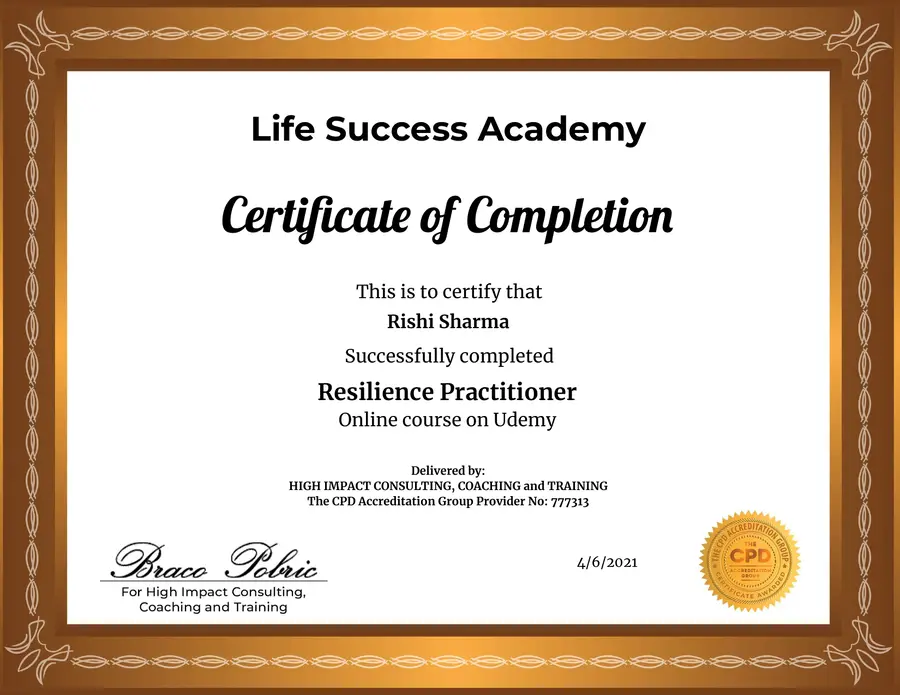
Resilience Practitioner
Leading engineering organisations through rapid growth, budget cuts, and organisational change requires a particular kind of durability — not stubbornness, but structured resilience. This CPD-accredited certification delivered by the High Impact Consulting group gave me a practitioner-level framework for understanding resilience as a set of learnable behaviours, not a fixed personality trait.
I applied it first to myself, then to how I coach the people around me. When you are leading 250 engineers through ambiguity, knowing how to build and sustain resilience in a team is not a soft skill — it is a core engineering leadership competency.
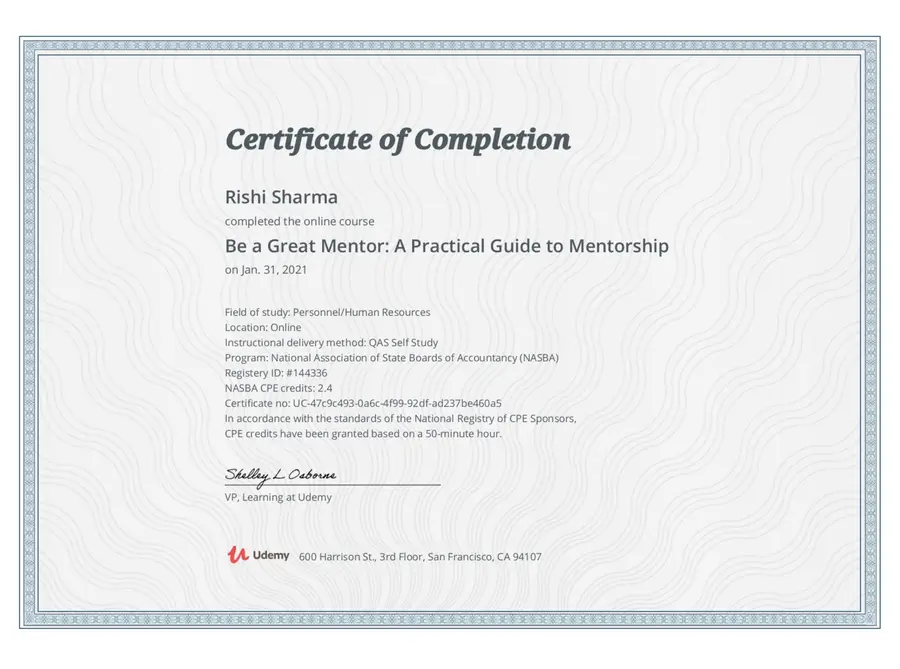
Be a Great Mentor: A Practical Guide
I have mentored engineers throughout my career without ever formalising the craft. This NASBA-accredited course changed how I think about the mentor-mentee relationship — not as advice-giving, but as structured investment in someone else's trajectory.
Having led teams of 250+ across multiple organisations, I came in expecting little new. I left with a structured framework I now use in every meaningful 1:1. The 2.4 CPE credits are the least of what it gave me. The shift from being a knowledgeable person in the room to being a genuinely useful mentor is a significant one, and this course made that distinction clear.
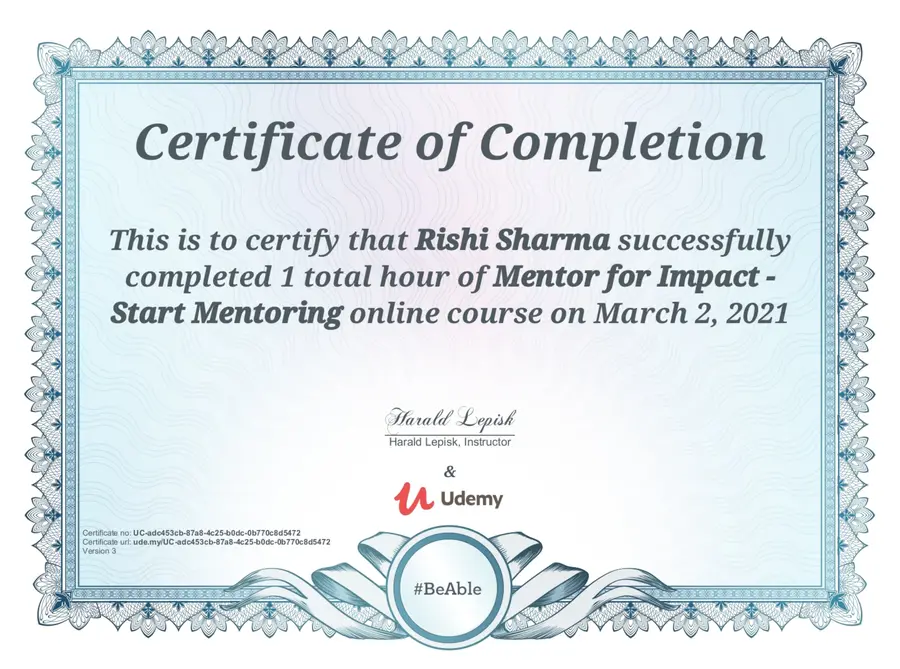
Mentor for Impact — Start Mentoring
Mentorship is one of the highest-leverage things a leader can do. This course cuts straight to the mechanics — how to structure early sessions, how to ask questions that unlock rather than direct, and how to measure whether the relationship is actually working.
I took this as part of a deliberate investment in early 2021 to become a more intentional mentor. The difference between being someone who gives good advice and someone who genuinely accelerates another person's career is craft. This course helped me build it.
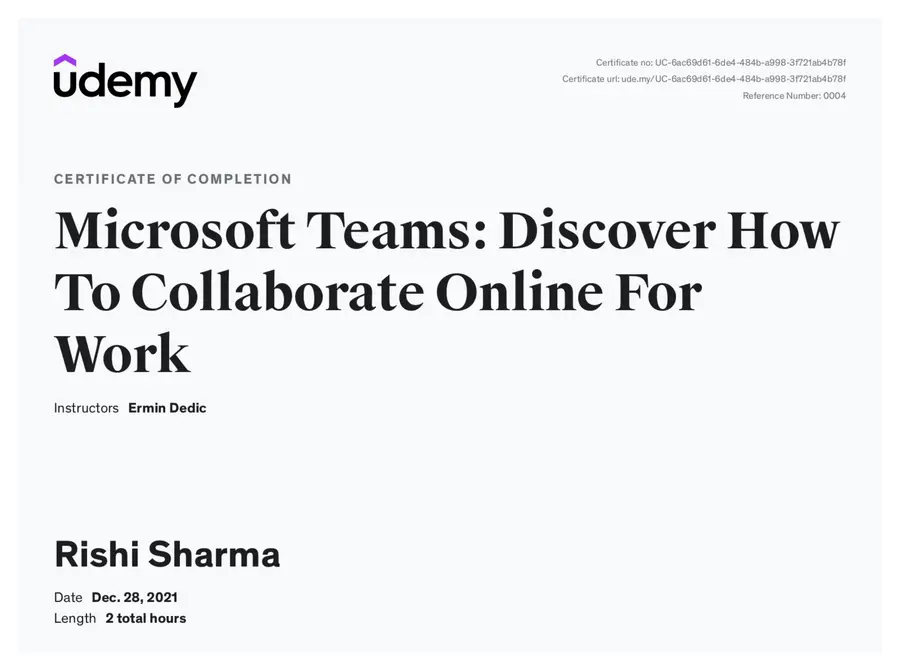
Microsoft Teams — Collaborate Online for Work
When you are leading distributed engineering teams — as I have done throughout my career — the collaboration tooling is not infrastructure, it is culture. The way teams communicate shapes how they think, how fast they decide, and how much trust they build across time zones.
I completed this to deeply understand what my teams were working with day-to-day, and to make informed decisions about configuration, governance, and integration when standing up new remote engineering environments. Leaders who dismiss tooling as "someone else's problem" are ceding one of the most powerful levers they have.
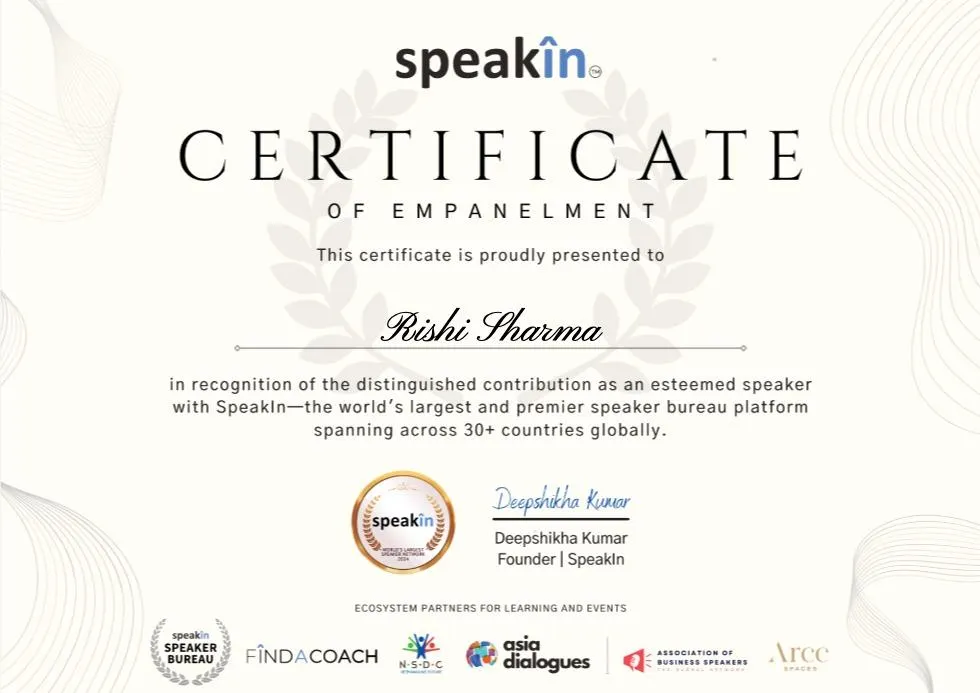
Certificate of Empanelment — Expert Speaker
SpeakIn is the world's largest speaker bureau, operating across 30+ countries and connecting organisations with verified expert speakers. Being empanelled is not something you apply for — it is something you are selected for based on demonstrated expertise, credibility, and the quality of what you bring to an audience.
My empanelment covers leadership, engineering management, AI strategy, and building high-performance teams. It is, in a sense, external verification of what I have spent 25 years earning. If you are building something and need someone who has been in the room where decisions actually happen, this is the credential that opens that door.
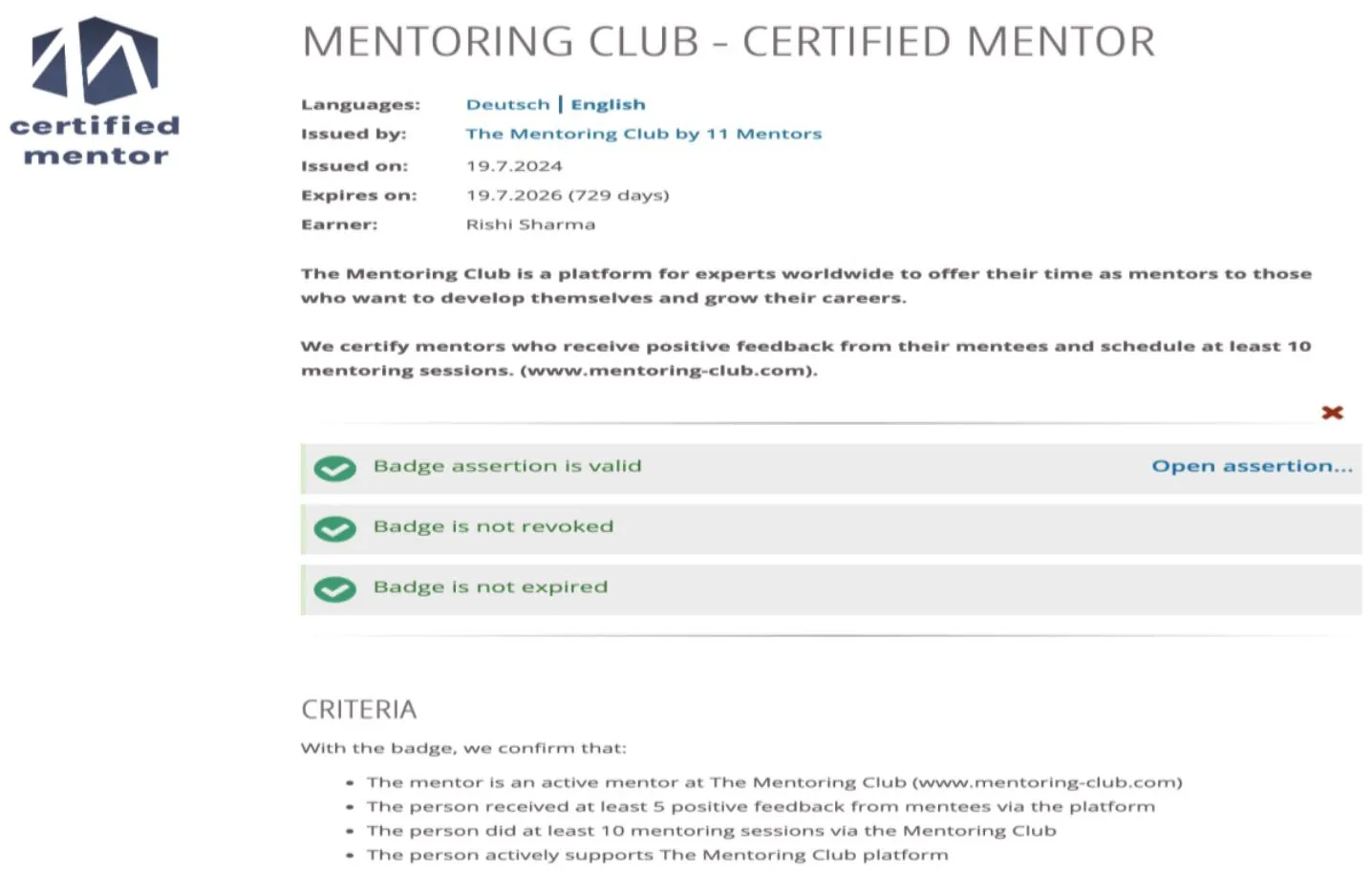
Certified Mentor
The Mentoring Club is a global platform that takes mentorship seriously — sessions are tracked, feedback is scored, and certifications are only awarded when you have demonstrated consistent impact across real sessions with real people.
I earned this certification in July 2024 after completing verified mentoring sessions with an average feedback score of 5.7 out of 6.0 and a 100% attendance rate. The certificate is not the point — the conversations are. But the certification is evidence that the conversations were genuinely useful, which is what every mentor should be measured against.
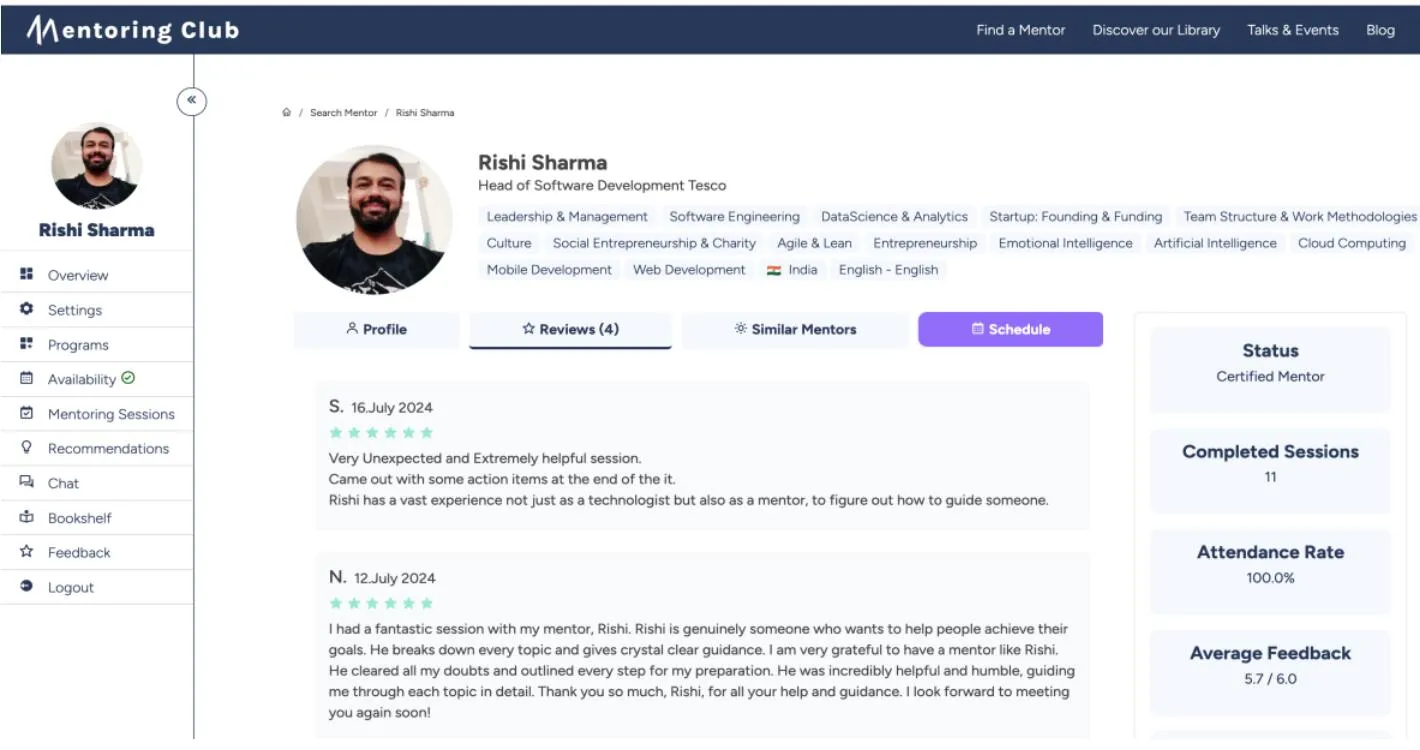
Verified Mentor Profile — 5.7 / 6.0
Numbers do not lie: 11 completed sessions, 100% attendance rate, 5.7 out of 6.0 average feedback. These are not self-reported metrics — they are platform-verified, session by session.
The reviews tell the actual story. "Rishi has a vast experience not just as a technologist but as a mentor, to figure out how to guide someone." That sentence captures what I have tried to build across 25 years of working with engineers, founders, and leaders at every stage. The platform just makes it measurable.
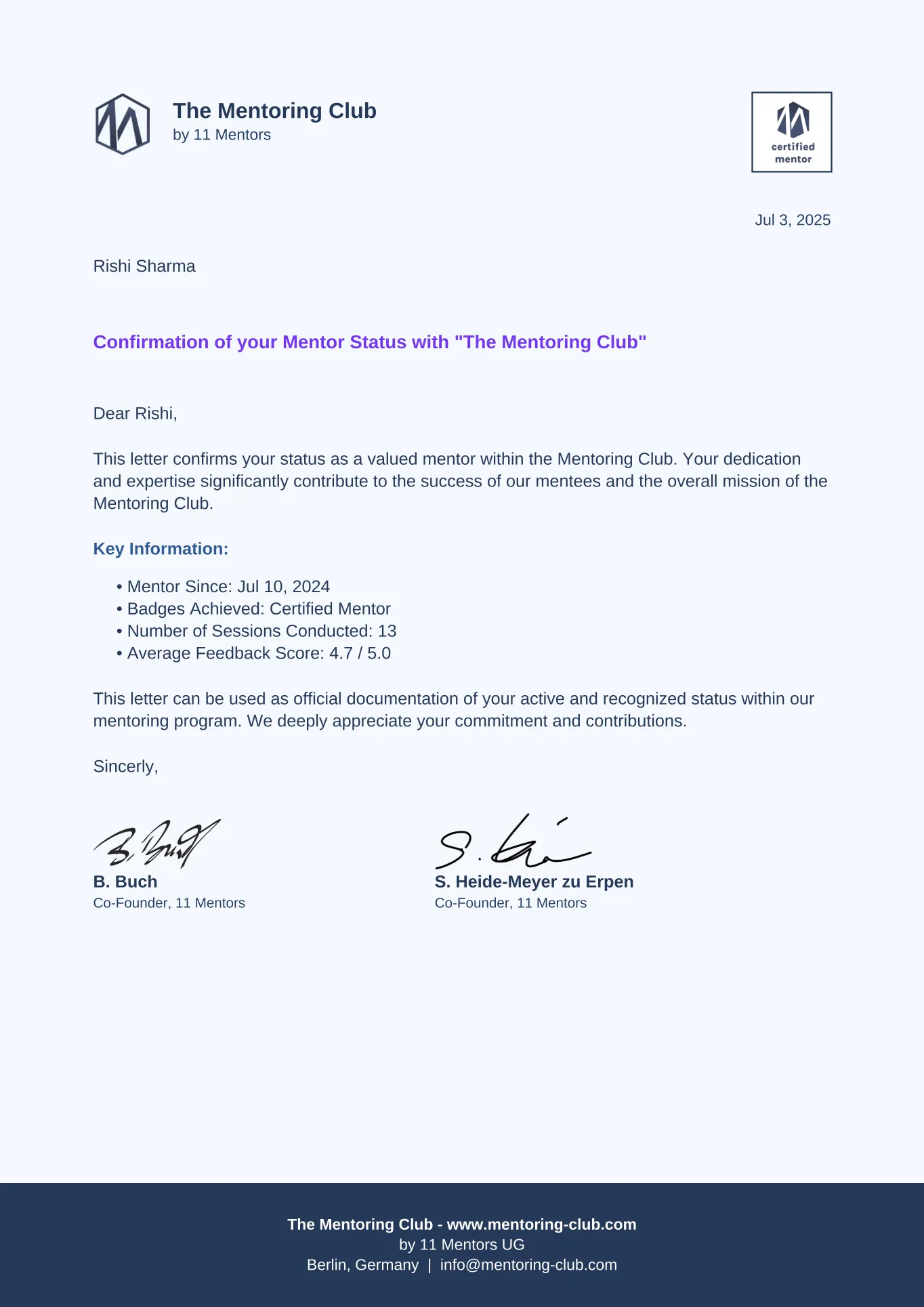
Mentor Status Confirmation — 4.7 / 5.0
By July 2025, the tally had grown: 13 verified sessions, a 4.7 out of 5.0 rating, and Certified Mentor status formally confirmed in writing by The Mentoring Club. This letter is the formal acknowledgement — the kind of document that exists because the platform tracks everything and the score has to mean something.
What the letter does not capture is the texture of those conversations — founders trying to figure out whether to hire their first engineer, senior developers wondering if leadership is the right move, and early-career technologists needing someone to tell them they are further along than they think. Each of those 13 sessions mattered more than any certification that followed.
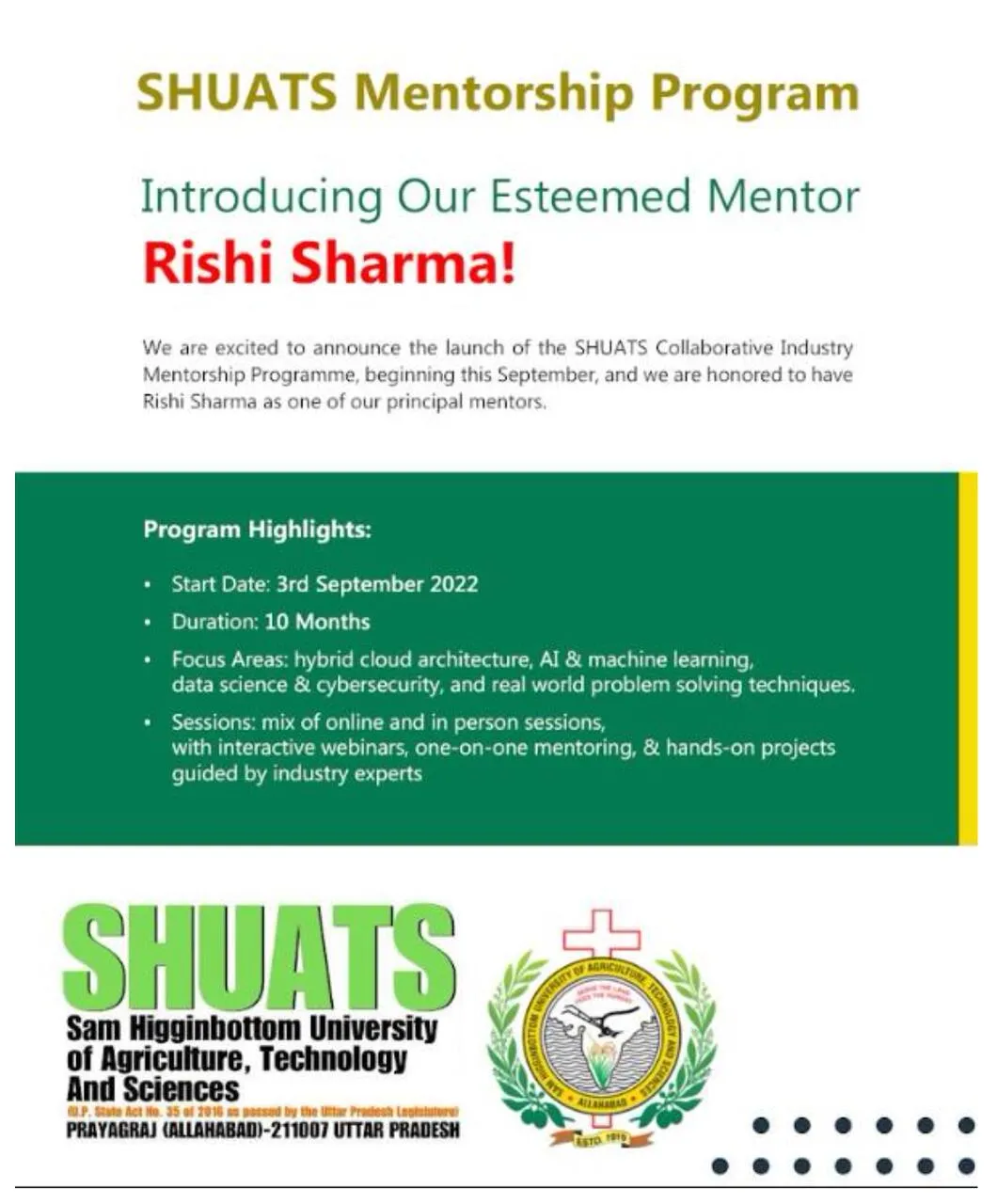
Esteemed Mentor — 10-Month Programme
Sam Higginbottom University of Agriculture, Technology and Sciences reached out in 2022 to bring me in as a mentor for a 10-month structured programme connecting students with industry practitioners. The university chose me specifically for the depth of my engineering and leadership background.
Working with students at this stage — where they are technically capable but have never navigated a real organisation — is a different kind of mentorship than working with experienced professionals. The questions are rawer, the stakes feel higher to them, and the impact of a well-timed piece of perspective is disproportionate. Ten months. Proper commitment, not a one-off talk.
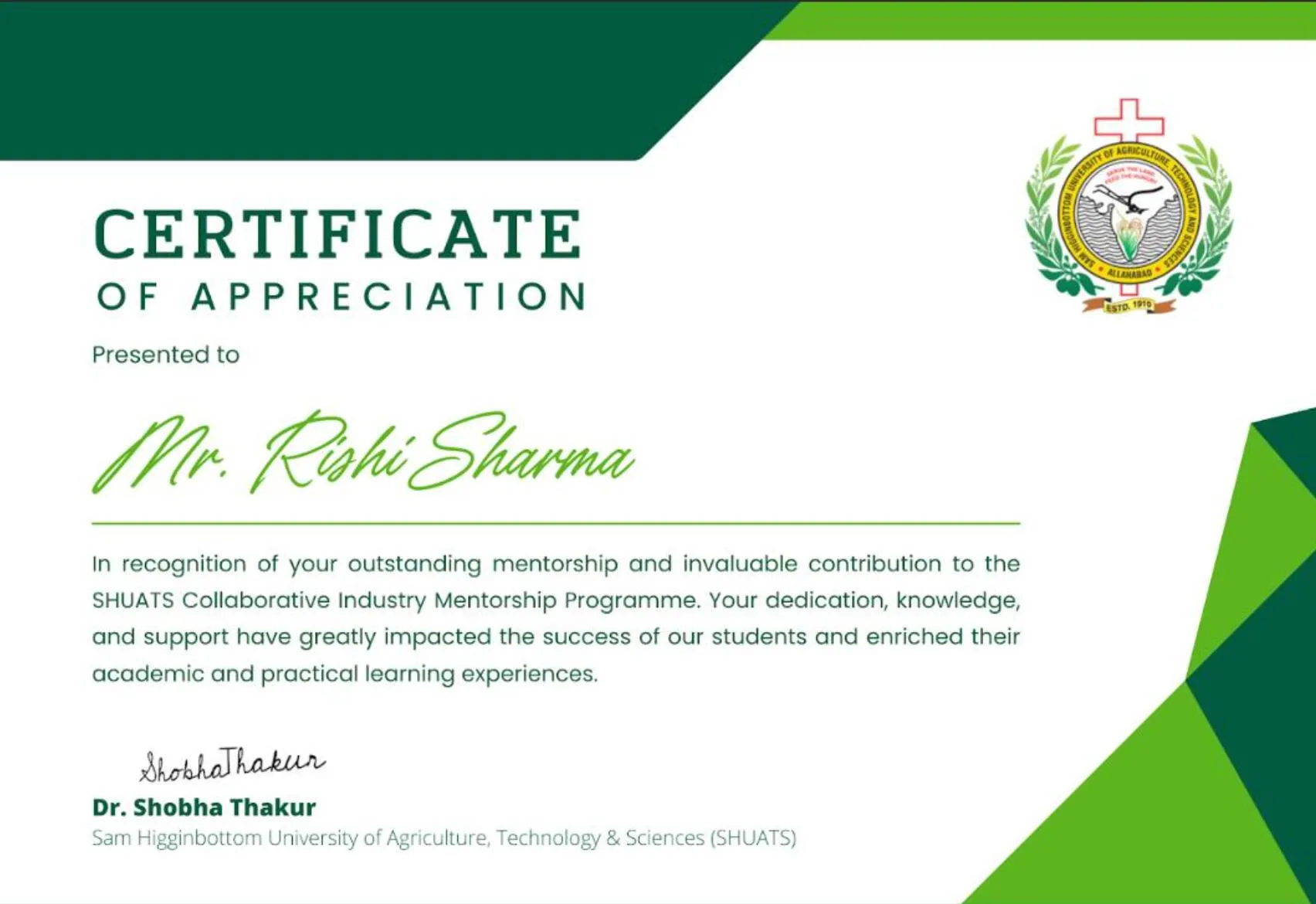
Certificate of Appreciation
This certificate from SHUATS, signed by Dr. Shobha Thakur, formally recognised my contribution to their industry mentorship programme. Appreciation certificates are often reflexive — you get them for showing up. This one felt different because I had put in real time across the year, not just a cameo.
University-industry bridges matter. The students I worked with were talented and technically grounded but had no map for how large engineering organisations actually operate. Helping them build that map — before they made expensive early-career mistakes — is exactly the kind of leverage I find worth the investment.
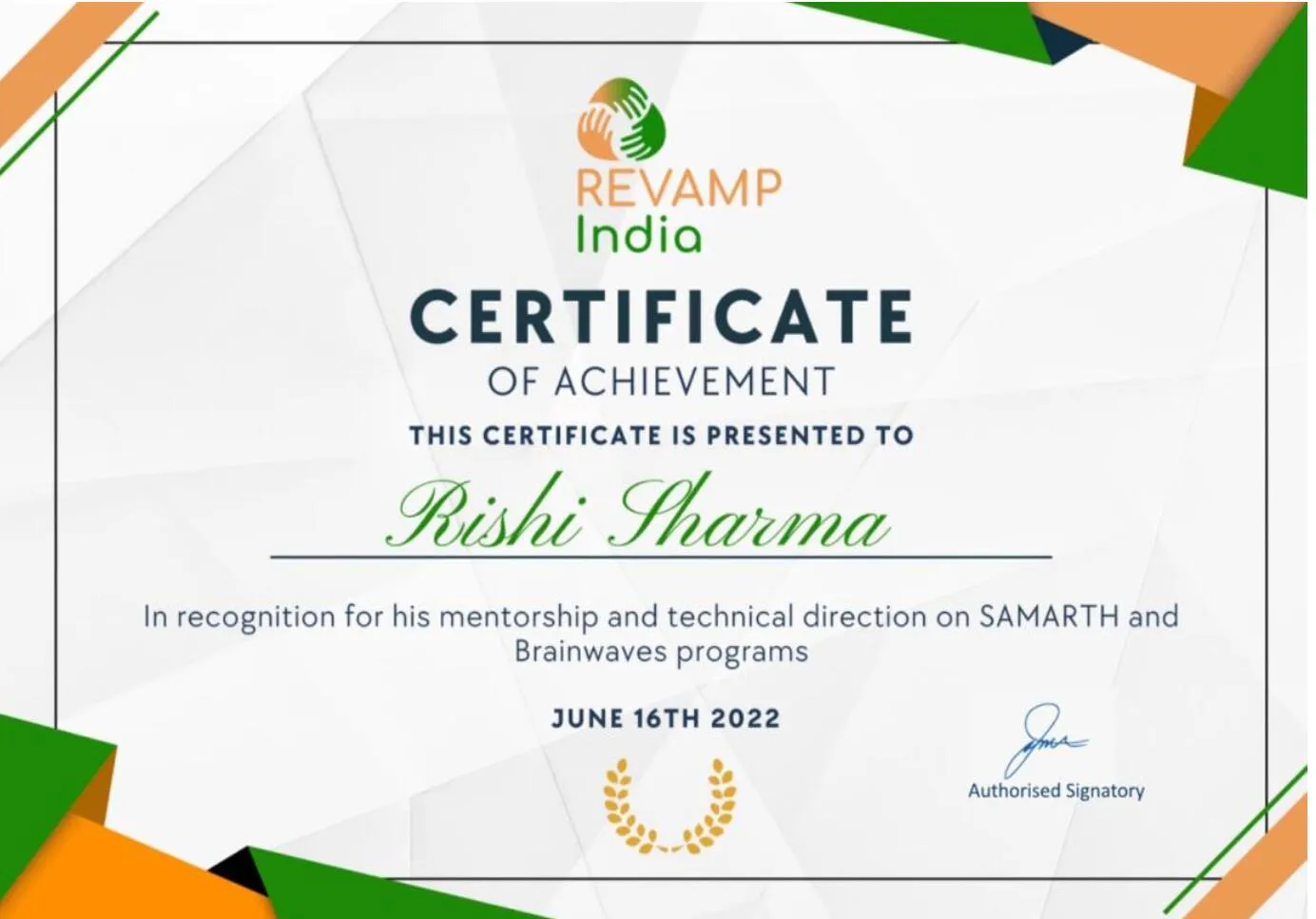
Certificate of Achievement — REVAMP India
REVAMP India's SAMARTH initiative — run in partnership with Brainwaves — is a programme built around connecting young people with experienced practitioners who can genuinely accelerate their trajectory. This was social mentorship with structure: defined outcomes, tracked impact, real accountability.
I was awarded this certificate in June 2022 in recognition of my contribution to the programme. These engagements matter to me beyond the credential — investing in the next generation of Indian technologists and leaders is part of what I believe experienced practitioners should be doing with their time, not just their money.
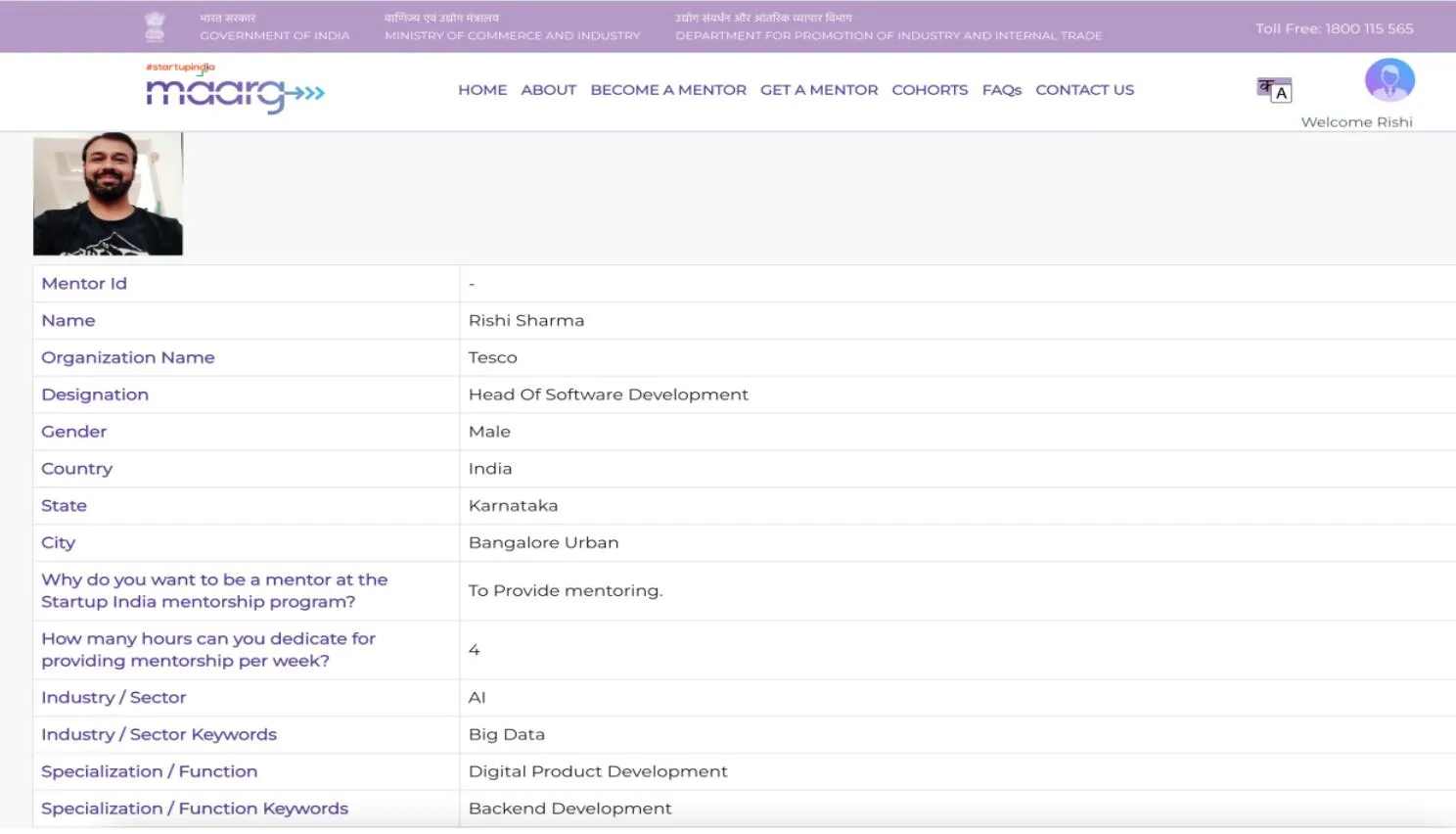
MAARG Mentor — Startup India
MAARG — Mentorship, Advisory, Assistance, Resilience, and Growth — is the Government of India's flagship mentor network for startups, operated through the Startup India initiative. Being listed as a verified mentor on this platform puts you in front of founders building real companies with real stakes.
My mentorship domain on MAARG covers AI strategy, digital product development, and scaling engineering teams — the three areas where I have the most to give. Government-backed mentor networks like this exist because founding a startup is genuinely hard and access to experienced guidance is unevenly distributed. I am here to be part of closing that gap.