The Thinking Machine Chronicles #0011: The Science of Control: Norbert Wiener and Cybernetics
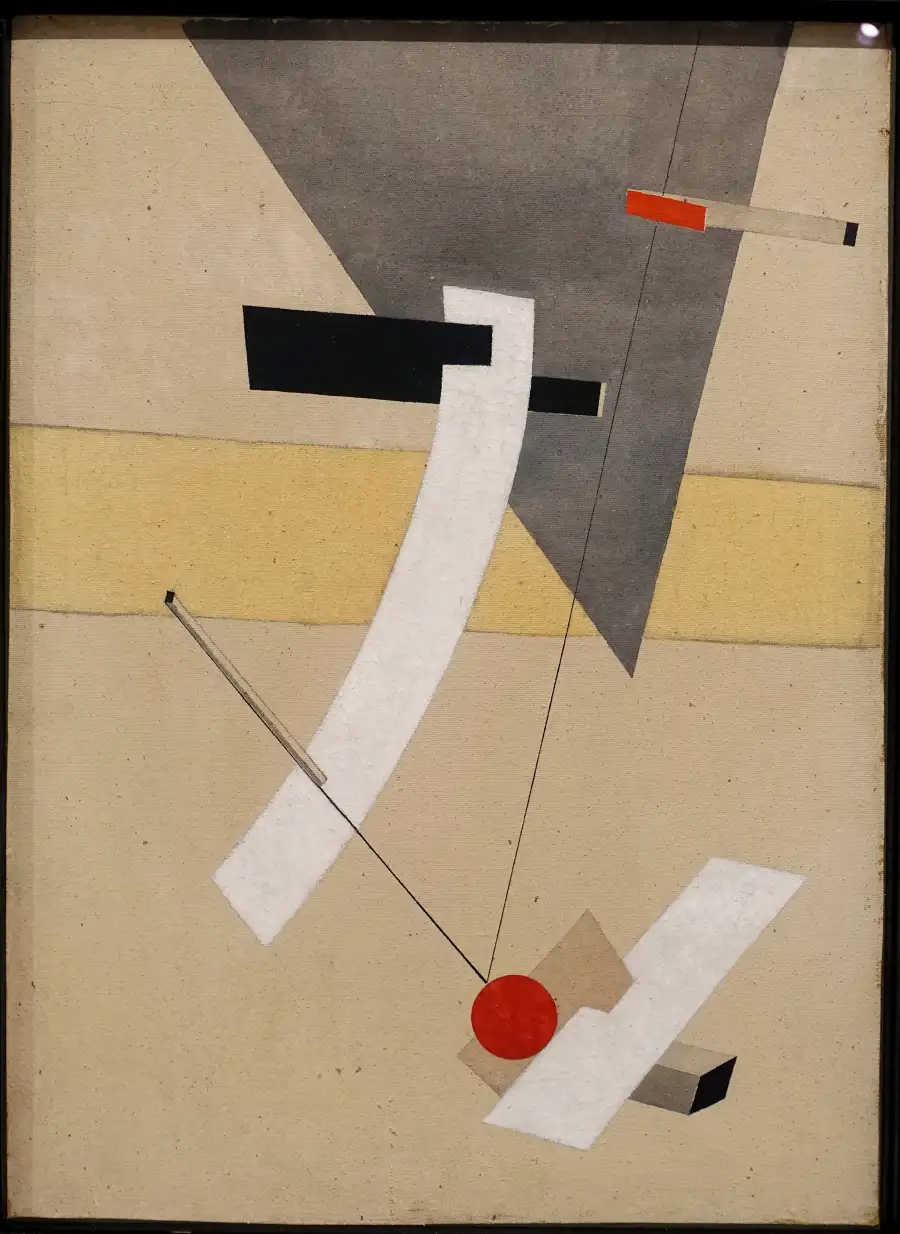
El Lissitzky, Proun 12E, 1923. Oil on canvas. Busch-Reisinger Museum, Harvard University. Public domain (CC0). The Proun series, geometric constructions poised between architecture and painting, prefigures the systems thinking Wiener would formalise twenty-five years later.
Era 1 · The Foundations (1936–1955) A mathematician who spent WWII teaching anti-aircraft guns to correct their own errors concludes that feedback, communication, and control are a single science, one that applies equally to brains, thermostats, and societies.
The World in 1948
The year 1948 opened with an assassination and closed with a declaration. On 30 January, Mahatma Gandhi was shot dead by Nathuram Godse in New Delhi's Birla House, four months after he had led India through the partitioned birth of two nations from one empire. In May, the British Mandate in Palestine expired and David Ben-Gurion proclaimed the State of Israel; five Arab armies invaded before the ink was dry. On 24 June, Soviet forces sealed every rail line and road leading into West Berlin, triggering the Berlin Blockade, the first acute crisis of the Cold War,which the Western Allies met not with force but with an eleven-month airlift of 200,000 flights and 2.3 million tonnes of food and coal. In November, Harry Truman defeated Thomas Dewey in a presidential election that every polling organisation in America had called wrong. On 10 December, the United Nations General Assembly adopted the Universal Declaration of Human Rights, drafted under Eleanor Roosevelt's chairmanship, asserting thirty articles of individual right against the power of states.
The intellectual atmosphere of 1948 was one of urgent synthesis, scholars from different disciplines reaching toward unified frameworks that wartime isolation had prevented. At Bell Telephone Laboratories in Murray Hill, Claude Shannon was finishing a two-part paper that would give engineers a rigorous mathematics of information. At MIT, Norbert Wiener had just submitted the manuscript of a book arguing that the same mathematics of feedback and control governed anti-aircraft guns, thermostats, nervous systems, and economies alike. The transistor had been demonstrated eighteen months earlier in the same building as Shannon's office. The Manchester Baby would run the first stored program in June. 1948 was the year the conceptual architecture of the modern age fell into place in a period of about twelve months.
The Gunner Who Could Not Lead a Jet
Norbert Wiener in 1940 was fifty-five years old, short, myopic, pipe-smoking, and constitutionally incapable of being uninteresting. He had been a child prodigy, a Harvard doctoral degree in mathematical logic at eighteen,and had spent two decades at MIT building a reputation in the continuous mathematics of Fourier analysis, Brownian motion, and harmonic analysis. When the United States mobilised for war, Wiener joined a project to solve a specific and urgent problem: anti-aircraft guns could not reliably hit fast aircraft.
The difficulty was prediction. A shell takes several seconds from firing to reaching altitude. The gunner must aim not where the aircraft is, but where it will be. At the speeds of 1940s aircraft, a human gunner aiming visually was too slow; even a mechanical predictor failed when pilots took evasive action, since an evasive pilot was actively trying to be unpredictable. Wiener and his collaborator Julian Bigelow attacked the problem statistically. They modelled the aircraft's future position as a stationary random process, represented the entire system, gunner, predictor, gun, shell,as a feedback loop, and asked: what is the optimal linear filter for estimating a future value of a random signal from its noisy past observations?
The mathematical answer, which they derived in a 1942 classified report quickly nicknamed the "Yellow Peril" for the colour of its binding, was the Wiener-Hopf prediction integral equation, the first rigorous solution to the optimal linear prediction problem. But the real insight arrived from watching a human operator track the aircraft through a gun sight. The operator's nervous system was doing exactly what the predictor circuit was doing: receiving a sensory signal, computing an estimate of future state, generating a corrective action, and feeding the result back into the next estimate. The human nervous system was a feedback control system. The gun predictor was a feedback control system. A thermostat was a feedback control system. A living organism regulating its body temperature was a feedback control system. Something mathematically deep was identical across all of them.
The Problem Wiener Was Solving
Wiener's insight was a claim about the structure of purposive behaviour. Before cybernetics, the behaviour of living organisms, their capacity to pursue goals, adapt to disturbance, maintain internal stability,was treated as fundamentally different from the behaviour of machines. Machines were caused; organisms were purposive. The philosophical vocabulary was either mechanist or vitalist, and neither camp had a rigorous account of how a machine could behave as if it were pursuing a goal.
Cybernetics dissolved the problem by identifying mechanism with mathematics. Any system that measures the difference between its current state and a desired state, and applies a corrective signal proportional to that difference, will exhibit goal-directed behaviour, regardless of whether it is made of neurons, hydraulics, or transistors. The goal is the set point; the corrective loop is the mechanism; the mathematics is the same in all three cases.
This is not reductionism. Wiener was not claiming that brains are thermostats. He was claiming that negative feedback is the mathematical genus of which thermostats, brains, and servo motors are species, that studying feedback at the mathematical level reveals something true about all of them, while leaving their physical implementation entirely open.
Feedback: The Mathematics
A feedback control system has four components: a plant (the process being controlled), a sensor (measuring the output), a comparator (computing the gap between desired and actual output), and an actuator (applying a corrective input). The corrective signal depends on the error:
where is the setpoint (reference) and is the measured output.
The simplest feedback law, proportional control,sets the actuator input to . This drives the output toward the setpoint but often leaves a steady-state offset or causes oscillation. Wiener recognised, as classical control engineers had also found, that the full power of feedback required integrating and differentiating the error. The PID controller (Proportional–Integral–Derivative) combines three mechanisms:
where:
- : corrects in proportion to current error
- : eliminates steady-state offset by accumulating past error
- : anticipates future error by responding to the rate of change
In the Laplace domain, with plant transfer function and PID controller , the closed-loop transfer function is:
Stability requires the poles of to lie in the left half of the complex plane. The Routh–Hurwitz criterion provides an algebraic test; the Bode and Nyquist plots provide geometric ones.
The Wiener-Hopf Filter
For the prediction problem itself, Wiener derived the Wiener-Hopf integral equation. Given a stationary random signal with autocorrelation function and cross-correlation with a desired signal (the aircraft's future position), the optimal causal linear filter satisfies:
In the frequency domain, the Wiener filter has transfer function:
where is the power spectral density of the input and is the cross-spectral density. This is the minimum mean-square error (MMSE) causal linear predictor, the solution Wiener derived for the anti-aircraft problem and which, once declassified and published, became the ancestor of the Kalman filter (Kalman, 1960), the LMS adaptive filter (Widrow and Hoff, 1960), and ultimately every noise-cancelling algorithm in consumer electronics.
The optimality condition above can be written compactly in matrix form for discrete systems. Given past observations stacked in a vector , the Wiener-Hopf equations become:
where is a Toeplitz autocorrelation matrix and is the cross-correlation vector. Solving this system by Levinson recursion, a algorithm,gives the optimal predictor coefficients.
Cybernetics (1948), publication and impact
Norbert Wiener's Cybernetics: Or Control and Communication in the Animal and the Machine (MIT Press / Wiley, November 1948) is part technical monograph and part philosophical manifesto. Wiener wrote a first draft during a visit to Mexico in 1946–47, working largely from memory without access to papers or library, which gives the book an unusual combination of rigorous mathematics and personal discursion. The title "cybernetics" was coined from the Greek κυβερνήτης (kubernētēs, "steersman" or "governor"), the same root that gave James Watt's centrifugal governor its name, and eventually through Norman Wiener and Norbert Elias the English word "governance." The book sold out its first printing within two months and was translated into Russian within a year. A revised second edition appeared in 1961.
Wiener, N. (1948). Cybernetics: Or Control and Communication in the Animal and the Machine. MIT Press / Wiley.
The Code: Feedback Control Simulator
The companion project implements a discrete-time feedback control simulator in pure Python. It models a first-order thermal plant and demonstrates open-loop versus PID control, showing how negative feedback eliminates the steady-state error that an unguided system accumulates,then implements a causal Wiener predictor using the discrete Wiener-Hopf equations:
@dataclass
class PIDController:
    Kp: float
    Ki: float
    Kd: float
    integral: float = 0.0
    prev_error: float = 0.0

    def step(self, setpoint: float, measured: float, dt: float) -> float:
        error = setpoint - measured
        self.integral += error * dt
        derivative = (error - self.prev_error) / dt if dt > 0 else 0.0
        self.prev_error = error
        return self.Kp * error + self.Ki * self.integral + self.Kd * derivative
The full project simulates a thermal system over 300 timesteps with and without feedback, demonstrates the Wiener-Hopf optimal predictor on a synthetic random walk, and shows the steady-state and overshoot behaviour that guided Wiener's analysis.
Why It Mattered
Cybernetics mattered at four levels simultaneously.
Philosophically, it dissolved the boundary between the animate and the inanimate at the level of mechanism. Before Wiener, goal-directed behaviour was either a biological mystery or a vitalist assertion. Cybernetics showed that negative feedback was the mechanism, that any system with a set point, a sensor, and a corrective actuator would behave purposively, regardless of substrate. The implication for AI was radical: you did not need to understand consciousness to build a goal-pursuing machine. You needed to build the feedback loop.
Scientifically, it gave neurophysiology a new vocabulary. Warren McCulloch, whose 1943 paper with Walter Pitts we saw in TMC #0005, became a central figure in the Macy Conferences on Cybernetics that Wiener helped organise between 1946 and 1953. Ten meetings brought together mathematicians, physicists, neurophysiologists, anthropologists, and psychologists under a shared framework. The concept of the brain as an information-processing feedback system entered neuroscience and never left.
Technologically, it launched control engineering as a rigorous discipline. The PID controller, which Wiener formalised and popularised,became the most widely deployed feedback algorithm in history. Every industrial process controller, every autopilot, every cruise control system, and every thermostat in the world runs a descendant of the equations Wiener wrote down in the 1940s.
For AI specifically, the most consequential legacy is the one that took longest to recognise: backpropagation, the algorithm that trains neural networks, is a gradient-descent feedback loop. The error at the output layer is computed, the gradient is propagated backward through the layers, and the weights are adjusted to reduce the error, step by step, exactly the negative feedback loop Wiener described. The connection would not be made explicit until the 1980s, but the mathematics was present in the "Yellow Peril" report of 1942.
What Came Next
If Wiener gave feedback systems their mathematical skeleton, his Bell Labs counterpart Claude Shannon gave information its precise anatomy. Shannon had been working in parallel, asking not "how do systems correct errors" but "how much information can a channel carry, and what is the minimum description of a source." Published in the same year as Cybernetics, Shannon's answer would prove even more foundational to the digital age: a bit is a bit, entropy is the only measure that matters, and every noisy channel has a capacity that can be approached arbitrarily closely with the right code. That is the next story: The Thinking Machine Chronicles #0012: A Mathematical Theory of Communication: Shannon Invents Information Theory.
References
- Wiener, N. (1948). Cybernetics: Or Control and Communication in the Animal and the Machine. MIT Press / Wiley. The original text; the 1961 second edition adds two important chapters on learning machines and self-reproducing automata.
- Wiener, N. & Hopf, E. (1931). Über eine Klasse singulärer Integralgleichungen. Sitzungsberichte der Preußischen Akademie der Wissenschaften, 696–706. The Wiener-Hopf integral equation, predating cybernetics by seventeen years.
- Galison, P. (1994). The Ontology of the Enemy: Norbert Wiener and the Cybernetic Vision. Critical Inquiry, 21(1), 228–266. The definitive account of the anti-aircraft origins; essential reading on how WWII shaped Wiener's epistemology.
- Conway, F. & Siegelman, J. (2004). Dark Hero of the Information Age: In Search of Norbert Wiener, the Father of Cybernetics. Basic Books. The most comprehensive biography.
- Åström, K.J. & Hägglund, T. (2006). Advanced PID Control. ISA Press. The modern engineering standard for PID theory, tuning, and implementation.
- Mindell, D.A. (2002). Between Human and Machine: Feedback, Control and Computing Before Cybernetics. Johns Hopkins University Press. Situates Wiener's work in the broader history of fire-control and servo engineering.