The Thinking Machine Chronicles #0010: The Transistor: The Tiny Device That Ended the Vacuum Tube Age
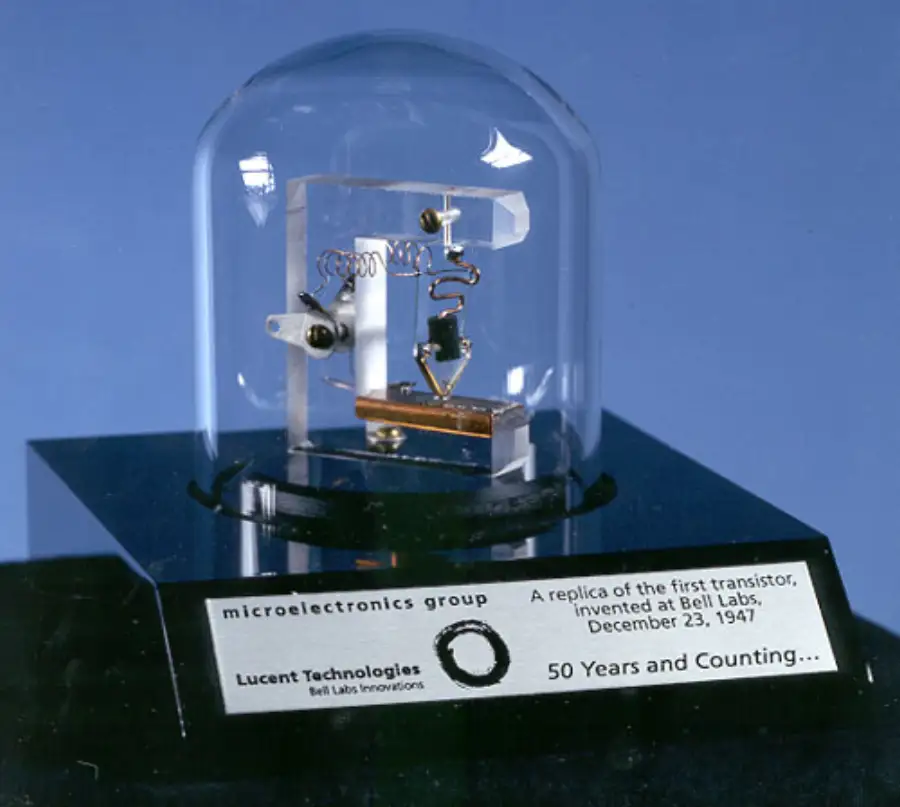
Replica of the first point-contact transistor, built by Walter Brattain and John Bardeen at Bell Labs, December 1947. Lucent Technologies replica, 1997. U.S. Federal Government photograph, public domain.
Era 1 · The Foundations (1936–1955) A wedge of germanium and two gold contacts in a Murray Hill laboratory replaces 18,000 hot, fragile vacuum tubes with a device smaller than a fingernail, and makes the personal computer imaginable for the first time.
The World in 1947
The year 1947 was one of violent gestation, old empires collapsing and new alignments hardening. In August, British India was partitioned into India and Pakistan in a matter of hours, setting off communal violence that killed between 200,000 and 2 million people and displaced twelve to fourteen million more. It was one of the fastest and bloodiest national births in modern history. In March, President Truman had gone before Congress to articulate what would become the Truman Doctrine,the principle that the United States would resist Soviet-backed insurgencies anywhere in the free world, effectively replacing the last pretence of postwar cooperation with declared ideological competition. In June, Secretary of State George Marshall outlined the European Recovery Program at Harvard, committing American industrial wealth to rebuild a continent that Soviet influence might otherwise absorb. The CIA was formally established in September. On 14 October, Chuck Yeager broke the sound barrier over California's Mojave Desert in the Bell X-1.
American science in 1947 was increasingly organised around what Vannevar Bush's July 1945 report had argued for: federal investment in basic research as the wellspring of national security and prosperity. Bell Telephone Laboratories, in Murray Hill, New Jersey, was the most technically sophisticated industrial research institution in the world, a place where quantum mechanics, materials science, and communications engineering were pursued with the rigour of a university and the resources of AT&T's long-distance monopoly. In Building 1, on a cold table in December 1947, three physicists in the solid-state physics group were about to produce the most consequential experimental result of the twentieth century.
Shockley, Bardeen, Brattain
William Shockley had joined Bell Labs in 1936 after his doctorate at MIT. His original proposal in 1939 had been for a field-effect semiconductor amplifier, a device that would control current flow in a semiconductor by applying an electric field perpendicular to its surface. The concept was correct, but the physics refused to cooperate: the surface states on the semiconductor trapped the applied field before it could penetrate the bulk. Shockley's 1939 device never worked.
After the war, Shockley assembled a solid-state physics group including John Bardeen, a quiet Iowa physicist who had written his doctoral thesis on the theory of metals,and Walter Brattain, an experimental physicist of extraordinary manual skill who had worked at Bell Labs since 1929. Bardeen suspected that the surface state problem might be solvable if the physics were better understood. Through 1947, he and Brattain worked on characterising the surface states of germanium.
On 16 December 1947, Brattain assembled the critical device. He pressed a triangle of gold foil, split to form two contacts separated by only 50 micrometres,against a germanium crystal sitting in an electrolyte. When current was injected through one contact and extracted at the other, the signal was amplified by a factor of approximately 18. The power gain was small but unambiguous. Bardeen and Brattain had built the first working point-contact transistor.
Shockley was not in the room. He had left for his holiday travel. When he returned and saw what had been demonstrated, he was at once elated and privately resentful, the device he had proposed in 1939 had at last been built, but by his subordinates, and using surface physics rather than the field effect he had originally envisioned. Within a month he had developed a complete theoretical analysis and conceived a superior device, the junction transistor, which he documented in detail in January 1948 and which became the basis for nearly all subsequent transistor technology. The interpersonal dynamics of the trio would eventually cause Bardeen and Brattain to leave Shockley's team; all three shared the Nobel Prize in Physics in 1956.
Semiconductor Physics: Why It Works
The vacuum tube, which had been the amplifying element in every electronic circuit since Lee de Forest's audion of 1906,works by thermionic emission: a heated cathode releases electrons into a vacuum, and a grid electrode controls how many reach the anode. It requires a heater, a glass envelope, a vacuum, and sufficient power to keep the cathode hot. A large computer like ENIAC needed 17,468 of them; they failed at a rate of several per day.
A transistor amplifies by controlling current flow through a solid semiconductor rather than a vacuum. The physics rests on the band structure of crystalline semiconductors.
Band Gap and Doping
Pure (intrinsic) silicon or germanium has a filled valence band and an empty conduction band separated by a band gap . At room temperature the thermal energy eV is too small to bridge the gap (silicon: eV; germanium: eV), so intrinsic conductivity is low.
Introducing dopant atoms transforms the picture. Adding phosphorus (five valence electrons) to silicon creates n-type material: phosphorus atoms contribute loosely bound electrons into the conduction band:
Adding boron (three valence electrons) creates p-type material: each boron atom accepts an electron from the valence band, leaving a mobile positive "hole":
The junction between n-type and p-type regions creates a depletion zone with a built-in electric field, the fundamental building block of every transistor and diode since 1947.
The Bipolar Junction Transistor (BJT)
Shockley's 1948 junction transistor (which superseded the point-contact device for almost all applications) consists of three doped regions: emitter, base, collector. In an npn BJT, the emitter is n-type, the base is a thin p-type region, and the collector is n-type.
When the base-emitter junction is forward biased, electrons from the emitter are injected into the thin base region. Because the base is intentionally thin (less than the minority carrier diffusion length), most of these electrons diffuse across the base and are swept into the collector by the reverse-biased base-collector junction. The small base current controls a much larger collector current :
where (current gain) is typically 50–500 for a well-made junction transistor. The Ebers-Moll equations describe the full DC behaviour:
where at room temperature is the thermal voltage, is the reverse saturation current, and , are the forward and reverse common-base current gains.
The practical consequence: a BJT in saturation (both junctions forward biased) acts as a closed switch; in cut-off (both junctions reverse biased) it acts as an open switch. This is the foundation of every digital logic gate.
Bell Labs' announcement and the secrecy debate
Bell Labs officially announced the transistor on 30 June 1948, six months after the first demonstration,describing it as a "semiconductor triode." AT&T held the patents and initially wanted to keep the technology proprietary, but concluded that broader licensing would be strategically safer. In 1952 Bell held a transistor symposium and licensed the patents to any manufacturer for a $25,000 fee. The symposium attendees included engineers from Texas Instruments, Motorola, and a small photographic equipment company called Sony. Texas Instruments, using a patent licence and an aggressive manufacturing programme, shipped the first commercial silicon transistor in 1954. The transistor radio arrived in 1955.
The 1952 licensing decision may have been the single most consequential technology transfer decision of the twentieth century. For a deeper treatment: Riordan, M. & Hoddeson, L. (1997). Crystal Fire: The Invention of the Transistor and the Birth of the Information Age. Norton.
The Code: A Transistor Model
The companion project implements the Ebers-Moll BJT model in pure Python, without any external dependencies. It simulates the transistor as both a switch and an analogue amplifier, and computes the output of a basic common-emitter amplifier stage:
def collector_current(
    self,
    vbe: float,
    vbc: float = -5.0,
) -> float:
    """
    Ebers-Moll collector current for an npn BJT.

    Args:
        vbe: Base-emitter voltage (V).
        vbc: Base-collector voltage (V). Default: -5 V (reverse biased, active region).

    Returns:
        I_C in amperes.
    """
    forward = self.Is * (math.exp(vbe / self.Vt) - 1)
    reverse = (self.Is / self.alpha_R) * (math.exp(vbc / self.Vt) - 1)
    return forward - reverse
The full project demonstrates switch behaviour (cut-off and saturation), the DC load line, small-signal voltage gain, and a side-by-side comparison of power consumption and switching speed between a 1940s vacuum tube and a 1947-era germanium transistor.
Why It Mattered
The transistor mattered at four timescales simultaneously.
Immediately: It solved the reliability crisis of large-scale computing. ENIAC failed at least every two days due to tube burnout; a transistorised equivalent would run for months unattended. The first transistorised computers, MIT Lincoln Laboratory's TX-0 (1956), IBM's 7090 (1959),demonstrated that machine-scale reliability was achievable.
Within a decade: The transistor made the first commercial computers economically viable. A vacuum tube computer required climate-controlled rooms, specialist technicians, and an institutional budget. A transistor computer was smaller, cooler, and far cheaper to maintain. IBM's transistor-based mainframes of the late 1950s put computing into corporations, hospitals, and universities that could never have afforded tube machines.
Within two decades: The planar transistor (Jean Hoerni, Fairchild Semiconductor, 1959) and the integrated circuit (Jack Kilby and Robert Noyce, 1958–1959) multiplied the transistor's impact by a factor that required a logarithmic scale to describe. By 1971, Intel's 4004 put 2,300 transistors on a fingernail of silicon. By 2024, modern smartphone chips contain over 20 billion.
Conceptually: The transistor completed a transition that had been implicit in digital computation since Turing's 1936 paper, a transition away from the idea that a computing machine had to be built from macroscopic, mechanical, or thermionic components. The fundamental operations of logic,AND, OR, NOT, are operations on information, and they can be implemented in any physical substrate that has two stable states. The transistor demonstrated that those two states could be as small as the quantum of charge on a doped semiconductor crystal.
What Came Next
The transistor gave computing its substrate, but the intellectual architecture of what computers would do, and what relationship they would have to human thought, was being worked out in parallel. In 1948, Norbert Wiener at MIT published Cybernetics: Or Control and Communication in the Animal and the Machine, proposing that feedback, information, and control were a single unified subject equally applicable to organisms and machines. Wiener's framework was the first attempt at a general science of intelligent systems,and it would shape not only computer science but neuroscience, control engineering, and eventually the theory of neural networks. That is the next story: The Thinking Machine Chronicles #0011: Wiener's Cybernetics and the Science of Control.
References
- Bardeen, J. & Brattain, W.H. (1948). The Transistor, A Semi-Conductor Triode. Physical Review, 74(2), 230–231. The original two-page announcement, submitted 15 June 1948.
- Shockley, W. (1949). The Theory of p-n Junctions in Semiconductors and p-n Junction Transistors. Bell System Technical Journal, 28(3), 435–489. Shockley's comprehensive theoretical treatment of the junction transistor.
- Ebers, J.J. & Moll, J.L. (1954). Large-Signal Behavior of Junction Transistors. Proceedings of the IRE, 42(12), 1761–1772. The paper that introduced the Ebers-Moll model used by every transistor circuit simulator since.
- Riordan, M. & Hoddeson, L. (1997). Crystal Fire: The Invention of the Transistor and the Birth of the Information Age. Norton. The definitive popular history; excellent on the personalities and the Bell Labs institutional context.
- Sze, S.M. & Ng, K.K. (2006). Physics of Semiconductor Devices (3rd ed.). Wiley. The standard graduate reference; Chapters 3–5 cover junction theory and the bipolar transistor in depth.
- Cheung, S.K. (2010). The Bipolar Transistor. University of California, Berkeley. Lecture notes for EECS 105. A compact modern treatment of the Ebers-Moll model derivation.