The Thinking Machine Chronicles #0009: ENIAC: Eighteen Thousand Vacuum Tubes and the Dawn of Electronic Computing
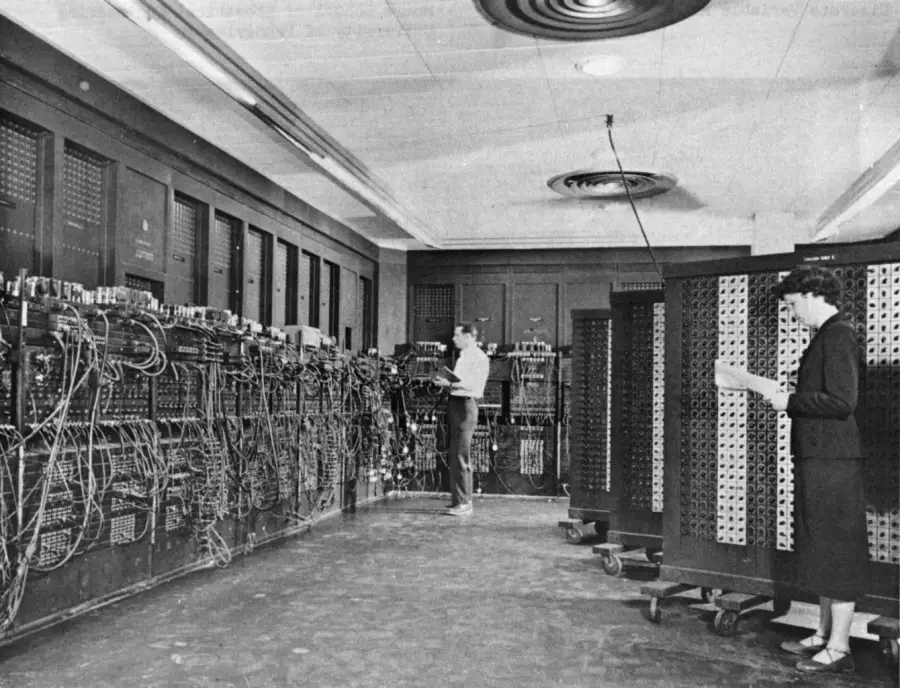
Glen Beck (background) and Betty Snyder Holberton (foreground) programming the ENIAC at the Ballistic Research Laboratory, Aberdeen Proving Ground, Maryland, c. 1947–1955. U.S. Army Photo, public domain.
Era 1 · The Foundations (1936–1955) A tennis-court-sized machine of glass and wire performs 5,000 additions per second, and the world finally sees what a computer can do.
The World in 1946
The year 1946 opened with the world exhaling from six years of total war. The United Nations held its inaugural General Assembly in London on 10 January, with fifty-one member states debating the architecture of a peace that the atomic bomb had made newly fragile. Winston Churchill, no longer Prime Minister but still the most listened-to voice in Western politics, delivered his "Iron Curtain" speech at Fulton, Missouri on 5 March, naming the new shape of danger: Soviet expansion behind a line from Stettin to Trieste. In Paris, the Fourth Republic was being negotiated into existence; in the Philippines, independence was formally declared on 4 July after decades of American administration. The Nuremberg Tribunal was hearing evidence that would result in twelve death sentences. The world that had been burned down was, in fits and starts, being rebuilt, but under the shadow of weapons that could erase cities in seconds, and under the surveillance of two superpowers whose mutual suspicion would define the next fifty years.
American science and engineering in early 1946 had just demonstrated what mobilised industrial capacity could achieve. The radar programmes, the proximity fuze, the B-29, the Manhattan Project, each was a case study in what happened when you gave excellent engineers unlimited money and a deadline. The Moore School of Electrical Engineering at the University of Pennsylvania had been one of those mobilised institutions. Since 1943 it had been under contract to the US Army's Ballistic Research Laboratory to build something unprecedented: an electronic machine that could compute artillery firing tables faster than the artillery could be deployed. On the afternoon of 14 February 1946, in a ceremony attended by Army brass, press, and a handful of scientists, that machine,ENIAC, was formally unveiled to the world. It was the first general-purpose electronic digital computer that the public had ever seen.
Eckert and Mauchly: The Engineers Who Built It
J. Presper Eckert and John Mauchly were not theorists. Eckert was 24 when the ENIAC project began, a meticulous electronics engineer with an instinct for circuit design that his colleagues found almost supernatural. Mauchly was a physicist turned computer visionary, ten years Eckert's senior, who had been thinking since 1940 about whether electronic circuits could be made to compute faster than the electromechanical relay calculators then available. He had visited John Atanasoff at Iowa State College in June 1941 and seen Atanasoff's prototype electronic computer, a visit that would later become the centrepiece of a damaging patent dispute. In 1942 Mauchly wrote a memorandum proposing an electronic difference analyser for the Moore School. The Army's need for faster ballistic computations gave his proposal its funding.
The contract was signed in June 1943. Eckert was the chief engineer; Mauchly was the principal consultant. The project was officially secret. The team worked in the Moore School basement for thirty months at a pace that destroyed health and marriages. The machine they built was unlike anything that had existed before in scale.
What ENIAC Was
ENIAC, the Electronic Numerical Integrator And Computer,occupied 1,800 square feet of floor space. It contained 17,468 vacuum tubes, 7,200 crystal diodes, 1,500 relays, 70,000 resistors, and 10,000 capacitors. It consumed 150 kilowatts of electrical power and required dedicated cooling. Its weight was approximately 27 tonnes. By every physical measure it was a machine of the first industrial age: enormous, hot, power-hungry, and prone to failure at least every day or two when a vacuum tube burned out.
But its speed was extraordinary. ENIAC could perform:
| Operation | Speed |
|---|---|
| Addition (10-digit numbers) | 5,000 per second |
| Multiplication (10-digit numbers) | 357 per second |
| Division | 38 per second |
| Square root | 29 per second |
For context: the best electromechanical relay calculator of 1945, Harvard's Mark I, could perform around three additions per second. A skilled human mathematician with an electric desk calculator could manage perhaps one multiplication per minute. ENIAC was roughly 1,000 times faster than the relay machines and a million times faster than a human. The first computation it ran after its public debut was a hydrogen bomb calculation for Los Alamos, a problem that would have taken human computers a hundred years to complete manually.
Programming ENIAC: The Problem of Rewiring
ENIAC was not a stored-program computer. Von Neumann's First Draft had been written by June 1945, but the stored-program concept was not retrofitted to ENIAC. Instead, ENIAC was programmed by physically reconnecting cables between its twenty independently operable accumulators (ten-digit decimal arithmetic units), a multiplier, a divider-square-rooter, three function tables, and two input/output units.
The interconnect panel had hundreds of sockets; each new program required the operator team to plug in dozens or hundreds of cables in the correct configuration and set roughly 3,000 switches. A simple ballistic trajectory might require a full day of setup before computation could begin. The computation itself took seconds.
This distinction, hours of setup for seconds of computation,is the central limitation that the stored-program architecture was designed to eliminate. ENIAC's programmers (a team that included six women: Kathleen McNulty, Mauchly, Frances Bilas, Elizabeth Jennings, Ruth Teitelbaum, and Betty Snyder Holberton) became extraordinarily skilled at this process, but it was always a physical act: moving cables, setting switches, reading circuit diagrams by hand.
The Accumulator and Its Arithmetic
Each of ENIAC's twenty accumulators held one ten-digit decimal number in a ring of ten decade counters, each counter holding one decimal digit as a ring of ten flip-flop circuits. The representation was decimal, not binary:
Addition was implemented by driving pulses into the decade rings: adding two numbers meant transmitting the addend as a sequence of pulses at the machine's clock rate of 100 kHz (10-microsecond cycle time), with each pulse incrementing the appropriate counter. Carry propagation was handled by a dedicated carry circuit that rippled through the decade stages. The time for one addition of two ten-digit numbers was therefore determined by the propagation time of carries through ten stages, approximately 200 microseconds, giving the 5,000-addition-per-second figure.
Multiplication used a table-lookup approach: each of ENIAC's three function tables could store 104 data points, and multiplication of two digits was performed by table lookup rather than repeated addition. This gave the 357-per-second multiplication rate, still roughly 1,000 times faster than any prior electronic or electromechanical machine.
ENIAC's public debut, 14 February 1946
The demonstration on Valentine's Day 1946 computed a ballistic trajectory in 20 seconds, a calculation that would have taken a human team approximately 12 hours. Press coverage was extensive; the New York Times called it "an amazing machine which applies electronic speeds for the first time to mathematical tasks hitherto too difficult and cumbersome for solution." Eckert and Mauchly had already incorporated the Electronic Control Company (later Eckert-Mauchly Computer Corporation) in late 1945, intending to commercialise the technology. Their subsequent patent applications would entangle the computing industry in litigation for decades.
ENIAC ran continuously at the Ballistic Research Laboratory from July 1947 until it was shut down at 11:45 p.m. on 2 October 1955. A partial reconstruction is on display at the University of Pennsylvania. The authoritative technical reference is the original 1946 paper: Goldstine, H.H. & Goldstine, A. (1946), "The Electronic Numerical Integrator and Computer (ENIAC)," Mathematical Tables and Other Aids to Computation, 2(15), 97–110.
The Code: An ENIAC Accumulator Simulator
ENIAC's arithmetic used decimal rings rather than binary, making it unusual among digital computers. The companion simulator implements a faithful ENIAC-style decimal accumulator, ten decade counters, ripple carry, and the same pulse-counting addition mechanism the real machine used:
def add(self, value: int) -> None:
    """
    Add a value to the accumulator using ENIAC's pulse-counting method.

    The real ENIAC transmitted 'value' pulses into the unit's decade ring.
    Each pulse increments the lowest-order digit; carry ripples upward.
    This models the ~200 µs accumulator cycle time at 100 kHz.
    """
    carry = value
    for i in range(self.NUM_DIGITS):
        total = self._digits[i] + carry
        self._digits[i] = total % 10
        carry = total // 10
    if carry:
        self._overflow = True
The full project includes the complete decimal accumulator, a ballistic trajectory computation (the same class of calculation ENIAC was built for), and a speed comparison that shows exactly why ENIAC was a million times faster than a human with a desk calculator.
Why It Mattered
ENIAC mattered for three reasons that had nothing to do with its specific design.
It proved the concept publicly. Colossus had proven that large-scale electronic computation worked, but in secret, and for a single purpose. ENIAC's public debut in February 1946 told the entire scientific and engineering community simultaneously that electronic computation at this scale was real, reliable enough for daily use, and extraordinarily fast. The existence of ENIAC was permission for everyone who had been speculating about electronic computers to start building.
It seeded the computing industry. Eckert and Mauchly's commercial ambitions, and the parade of scientists who visited the Moore School to see ENIAC operate, dispersed the knowledge of how to build such machines. The EDVAC project at Penn, the IAS machine at Princeton, the UNIVAC I, the IBM 701, all trace their direct intellectual lineage to ENIAC and the engineers who built it. The Moore School Lectures of summer 1946, where Eckert and Mauchly taught the basic principles of electronic computer design to an audience of 28 scientists from major American institutions, was perhaps the most consequential series of technical lectures in computing history.
It established the human relationship with the machine. The six women who programmed ENIAC, the "ENIAC Girls," a name they mostly rejected,developed the first professional discipline of computer programming. They wrote the code, debugged the hardware, and understood the machine more intimately than anyone else. They received no public credit at the 1946 unveiling; the photographs show the hardware. This pattern, programmers invisible, hardware celebrated,persisted in computing culture for decades.
What Came Next
ENIAC ran its programs by physical cable rewiring, which meant a new scientific problem required days of setup. Within two years, a quieter machine in a Manchester basement would solve that problem by implementing the stored-program architecture von Neumann had described. But before that architectural breakthrough, the physical miniaturisation that would eventually make computers personal, portable, and ubiquitous was already beginning in a Bell Laboratories room in Murray Hill, New Jersey. Three physicists were working on a sandwich of germanium and gold foil that would replace the vacuum tube entirely, and shrink what ENIAC filled with 18,000 tubes into something you could hold between two fingers. That story is next: The Thinking Machine Chronicles #0010: The Tiny Device That Made Everything Possible: The Transistor.
References
- Goldstine, H.H. & Goldstine, A. (1946). The Electronic Numerical Integrator and Computer (ENIAC). Mathematical Tables and Other Aids to Computation, 2(15), 97–110. The original technical paper describing ENIAC's architecture and performance.
- Eckert, J.P. & Mauchly, J.W. (1946). Report on the ENIAC. Technical Report, Moore School of Electrical Engineering, University of Pennsylvania. The primary engineering documentation.
- Stern, N. (1981). From ENIAC to UNIVAC: An Appraisal of the Eckert-Mauchly Computers. Digital Press. The definitive history of the Eckert-Mauchly machines and the patent disputes that followed.
- Light, J.S. (1999). When Computers Were Women. Technology and Culture, 40(3), 455–483. The authoritative account of the six women programmers and their erasure from the public record.
- Mauchly, J.W. (1981). The ENIAC. In N. Metropolis, J. Howlett & G.-C. Rota (eds.), A History of Computing in the Twentieth Century. Academic Press. Mauchly's own account of the machine's origins and his disputed visit to Atanasoff.
- Haigh, T., Priestley, M. & Rope, C. (2016). ENIAC in Action: Making and Remaking the Modern Computer. MIT Press. The most thorough modern scholarly treatment; challenges several myths about ENIAC's capabilities and history.