The Thinking Machine Chronicles #0008: As We May Think: Vannevar Bush Dreams of the Thinking Machine's Memory
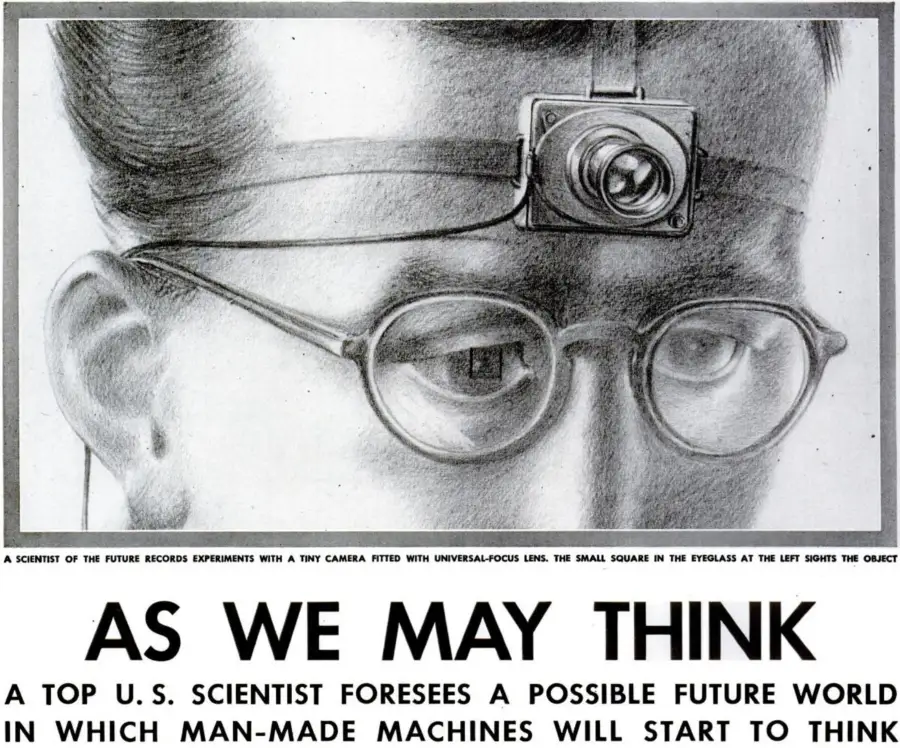
The Memex as illustrated in the September 10, 1945 condensed republication of "As We May Think" in Life magazine. A desk with microfilm reels, projection screens, and a keyboard, Bush's vision of the mechanised personal library. Time Inc., public domain via Wikimedia Commons.
Era 1 · The Foundations (1936–1955) The war is over. The man who ran American science asks: what do we do with all this knowledge?
The World in July 1945
The summer of 1945 was the hinge point of the twentieth century. On 16 July, the world's first atomic device detonated at Trinity, New Mexico, a flash visible two hundred miles away, followed three weeks later by the destruction of Hiroshima on 6 August and Nagasaki on 9 August, and Japan's surrender on 15 August. The Second World War, which had consumed somewhere between seventy and eighty-five million lives over six years, was over. In San Francisco, the United Nations Charter had been signed on 26 June by fifty nations, inaugurating the institutional architecture that would attempt to govern the peace. The Nuremberg trials were being organised. The British electorate had, in a result that shocked Churchill, thrown out the Conservative government in a landslide on 5 July, electing a Labour government under Clement Attlee that would create the National Health Service and begin the dismantling of the British Empire. The shape of the Cold War,Soviet armies across Eastern Europe, American atomic monopoly, two industrial blocs hardening against each other, was already visible to anyone who looked carefully.
American science in July 1945 stood at a peculiar inflection point. For four years, an unprecedented concentration of talent had been pointed at a single problem: winning the war. The National Defense Research Committee and its successor, the Office of Scientific Research and Development, had coordinated research across thousands of scientists and engineers, radar at MIT's Radiation Laboratory, proximity fuzes at Johns Hopkins, the atomic bomb at Los Alamos, synthetic rubber, penicillin, blood plasma. The man who had run all of it,director of the OSRD, chairman of the NDRC, science adviser to the President, was Vannevar Bush of MIT. As the war ended and scientists began to ask what came next, Bush was already thinking about a different kind of problem: not how to build weapons, but how to organise and navigate the knowledge that science had generated. In July 1945, The Atlantic Monthly published his answer.
The Science Czar and His Library Problem
Vannevar Bush was born in 1890 in Everett, Massachusetts, the son of a Universalist minister. He took his doctorate at MIT and Harvard in 1916, joined the MIT faculty, and by the 1930s had built the Differential Analyzer, one of the most powerful analogue computers of its era, a room-sized machine of gears and rods that could solve differential equations by mechanical integration. He had also supervised the early careers of Claude Shannon and Frederick Terman, who would later build Silicon Valley. By 1939 he was president of the Carnegie Institution and vice chairman of the National Advisory Committee for Aeronautics. When war came, Roosevelt trusted him completely, and Bush became the most powerful figure in American science, controlling a budget that at its peak exceeded $100 million per year.
But Bush's obsession, even in the middle of the war, was something he had been thinking about since the 1930s: the problem of what he called the "growing mountain of research." Science had accelerated to a pace where no single person could read everything relevant to their field, let alone synthesise it. Important discoveries were duplicated because researchers did not know the work had already been done. Connections between ideas in different disciplines went unmade for years. The tools for indexing and retrieving scientific knowledge, classification schemes, card catalogues, printed abstracts,had not kept pace. They were, in Bush's assessment, "totally inadequate" for the volume of knowledge now being produced. He wrote the core of what would become "As We May Think" in the late 1930s, put it aside during the war, and returned to it in 1945 as the end approached. The July 1945 Atlantic article is the result.
The Memex Vision
The centrepiece of "As We May Think" is a device Bush calls the Memex, an abbreviation of memory extender. It is not a computer in any conventional sense. Bush imagined it as an electromechanical desk containing microfilm reels loaded with the owner's entire professional library,books, records, communications, together with projection mechanisms to display any document on a pair of screens, a keyboard and buttons for navigation, and a camera for photographing new notes or documents to add to the collection.
What made the Memex different from a microfilm reader, and what made the article so electrifying to everyone who read it,was a single operational concept: associative trails. Bush observed that the human mind does not work by indexing. It works by association. When you think of one thing, it suggests another by some connection of similarity or circumstance, and that suggests a third, and so on. "The human mind operates by association," he wrote. "With one item in its grasp, it snaps instantly to the next that is suggested by the association of thoughts."
A conventional library forces you to abandon this process. You follow an index to a shelf, read a book, and if you want a related text, you must return to the index, locate the call number, travel to a different part of the stack, and start over. The associative thread is broken. The Memex would preserve it. The operator could browse from document to document using buttons and levers, and at any point could create a trail, a named, permanent sequence of documents and annotations, linked in whatever associative order made sense to the researcher at that moment. Trails could be shared with other Memex users. They could be published alongside papers. A scientist could leave behind not just their findings but their entire process of reasoning: the documents they read, the connections they drew, the marginal notes they made.
Bush's proposed mechanism was entirely physical, microfilm, photocells, dry photography,but the logical structure he described maps directly onto what we now call a hypertext system:
| Memex Concept | Modern Equivalent |
|---|---|
| Document stored on microfilm | Web page or file |
| Association code linking two documents | Hyperlink |
| Named trail (sequence of linked documents) | Curated link list / bookmark chain |
| Marginal annotations on documents | Web annotations / notes |
| Sharing a trail with a colleague | Sharing a URL |
| Full-text retrieval by keyword | Search engine query |
The difference between the Memex and a search engine is precisely this: search returns a ranked list of documents matching keywords. A trail is a curated sequence embodying human judgment about how documents connect. Bush believed the trail was intellectually richer, that the associations a scientist built over a lifetime were themselves a form of knowledge, more valuable than any individual paper.
The Information Overload Problem, Quantified
Bush opens his article with a striking arithmetic. In 1945, a skilled typist could produce roughly 1,000 words per hour. A PhD thesis typically ran 80,000 words. The number of scientific journals published annually was already in the thousands. The number of scientific papers published each year was in the hundreds of thousands. A scientist working in a reasonably active field would need to read approximately 200 papers per year to stay current, but might need to be aware of connections to thousands more. No human being could read at that rate and still do research.
Bush's estimate, which he had refined over years:
"The investigator is staggered by the findings and conclusions of thousands of other workers, conclusions which he cannot find time to grasp, much less to remember, as they appear. Yet specialisation becomes increasingly necessary for progress, and the effort to bridge between disciplines is correspondingly superficial."
The mathematical structure of the problem is one of exponential growth meeting linear human capacity. If the number of scientific papers grows at rate per year, the total corpus after years is proportional to . Human reading speed and retention are bounded by biological constants. The gap between what exists and what any one person can read widens without bound:
where is the initial corpus size, is the annual growth rate of the literature, is the human reading rate in papers per year, and is elapsed time. For any , as . Bush was the first person to frame the information management problem in these terms, and every library system, search engine, and knowledge management tool built since has been an attempt to address the same widening gap.
"As We May Think", Vannevar Bush, 1945
The article was published in two versions: the full text in The Atlantic Monthly, Volume 176, Issue 1, July 1945, pages 101–108; and an illustrated condensation in Life magazine, September 10, 1945. The Life version (shown in the hero image above) added artist's sketches of the Memex and was seen by an estimated five million readers. The full text is in the public domain and freely available at theatlantic.com and through Project Gutenberg. The article was Bush's most widely read work; he later said it was the piece of his career he was most proud of. J.C.R. Licklider, Douglas Engelbart, and Ted Nelson all cited it directly as the inspiration for their own foundational work.
The Code: A Memex Simulator
The Memex's logical structure, documents, associative links, named trails, annotations, and the contrast between index-based search and trail-based navigation,is straightforward to implement in Python. The companion simulator, memex.py, builds a complete in-memory Memex with all five operations Bush described:
def create_trail(self, name: str, doc_ids: list[str],
                 annotations: list[str] | None = None) -> Trail:
    """
    Create a named associative trail — Bush's key invention.

    Unlike keyword search (which returns a ranked list), a trail is a
    *curated sequence* of documents in a human-chosen associative order,
    with optional marginalia at each step.  Trails can be shared and
    published.  This is the logical predecessor of the hyperlink.
    """
    steps = []
    for i, doc_id in enumerate(doc_ids):
        if doc_id not in self._docs:
            raise KeyError(f"Document '{doc_id}' not found in Memex")
        annotation = (annotations[i] if annotations and i < len(annotations)
                      else "")
        steps.append(TrailStep(doc_id=doc_id, annotation=annotation))
    trail = Trail(name=name, steps=steps)
    self._trails[name] = trail
    return trail
The full project demonstrates three things Bush specifically described: keyword search (fast but associatively blind), trail navigation (curated and sequential), and what Bush called "compressed knowledge", the ability to hand a colleague a trail that encodes weeks of reading in a transferable sequence.
The full project includes memex.py with all five operations, a demo loading twelve actual 1945-era scientific papers (as excerpts), building two trails, and running a direct comparison between search results and trail-based navigation of the same corpus.
Why It Mattered
"As We May Think" mattered not because anything in it was built in 1945, none of it was, in the form Bush described. It mattered because it changed what people thought was possible and worth attempting.
It introduced the concept of hypertext. Ted Nelson, who coined the word "hypertext" in 1965 and spent thirty years building Xanadu, cited Bush directly as his starting point. Nelson's insight, that text could be non-sequential, that links between passages were a first-class feature of writing rather than a workaround,is Bush's associative trail, formalised. Tim Berners-Lee, designing the World Wide Web in 1989, cited both Nelson and, through him, Bush. The web's fundamental primitive, the anchor tag and the URL,is a materialisation of Bush's association code.
It defined the human-computer interaction research agenda. J.C.R. Licklider read "As We May Think" at MIT in the late 1940s and spent the 1950s thinking about what he called "man-computer symbiosis", the idea that computers should augment human cognition rather than replace it. His 1960 paper of that title is the direct intellectual descendant of Bush's 1945 vision. Licklider went on to run ARPA's Information Processing Techniques Office, where he funded the work that produced time-sharing systems, ARPANET, and the interactive computer paradigm. The entire tradition of human-computer interaction research,Engelbart's oN-Line System, the mouse, windows, the Macintosh, flows through this lineage.
It separated storage from retrieval, and retrieval from navigation. Before Bush, the dominant metaphor for a library was physical: things were stored in places, and you found them by going to the right place. Bush introduced the idea that how you navigate knowledge, the trails you make, the associations you follow,is itself a form of knowledge worth preserving. This is the intellectual foundation of tagging, social bookmarking, recommendation systems, and the "related articles" features of every modern knowledge base.
It was wrong about the mechanism and right about everything else. Bush imagined microfilm and photocells. What arrived was transistors, then integrated circuits, then the internet. The physical substrate was completely different. But the logical architecture, documents, links, trails, annotations, search,maps almost perfectly onto the web. A 1945 prediction about the form of the machine was entirely wrong; a 1945 prediction about the function it would serve was entirely right. That combination of wrong physics and right logic is rarer than it looks.
What Came Next
Bush had described a machine that could organise knowledge. Within months, an actual machine, one built from 18,000 vacuum tubes in a basement at the University of Pennsylvania,was about to demonstrate that electronic computation could operate at speeds no human could match. ENIAC, unveiled in February 1946, was not a Memex; it could not store documents or navigate trails. But it could perform 5,000 additions per second, and its existence, the fact of a working large-scale electronic computer,transformed what everyone around Bush began to imagine was possible. The next step in this chronicle is the machine itself: The Thinking Machine Chronicles #0009: ENIAC: Eighteen Thousand Vacuum Tubes and the Dawn of Electronic Computing.
References
- Bush, V. (1945). As We May Think. The Atlantic Monthly, 176(1), 101–108. The original full-text publication; freely available at theatlantic.com. One of the most cited articles in computer science history.
- Bush, V. (1945, September 10). As We May Think [condensed]. Life, 19(11), 112–124. The illustrated condensation that reached five million readers; the Memex illustration reproduced above is from this version.
- Licklider, J.C.R. (1960). Man-Computer Symbiosis. IRE Transactions on Human Factors in Electronics, HFE-1(1), 4–11. Licklider's operationalisation of Bush's vision; the paper that set the ARPA computing research agenda.
- Nelson, T.H. (1965). Complex information processing: A file structure for the complex, the changing and the indeterminate. In Proceedings of the 20th National ACM Conference, 84–100. Nelson's paper coining "hypertext" and explicitly extending Bush's trail concept.
- Berners-Lee, T. (1989). Information Management: A Proposal. CERN internal memo. The document proposing the World Wide Web; cites Nelson and through him Bush as direct antecedents.
- Nyce, J.M. & Kahn, P. (eds.). (1991). From Memex to Hypertext: Vannevar Bush and the Mind's Machine. Academic Press. The definitive scholarly collection on Bush's influence; includes Bush's earlier 1939 draft, correspondence, and critical essays.
- Zachary, G.P. (1997). Endless Frontier: Vannevar Bush, Engineer of the American Century. Free Press. The authoritative biography; covers Bush's scientific management career and the origins of "As We May Think."